

Who People.ai is for
People.ai is for revenue leaders who have stopped trusting their own CRM. If you are a CRO, VP of Sales, or RevOps lead at a company large enough that reps log maybe half of what they actually do, People.ai exists to close that gap. It captures the emails, meetings, and calls automatically, writes them back to the CRM, and then layers deal and account intelligence on top so your forecast reflects reality instead of optimism.
It is a poor fit for small teams and individual reps. The pricing is enterprise, the implementation takes real project time, and most of the value only shows up once you have enough activity and enough people to find patterns in. A 10-rep startup that just wants Salesforce to stay clean will get there faster and cheaper with Scratchpad. People.ai pays off when the data problem is genuinely large and the cost of a blown forecast is genuinely high.
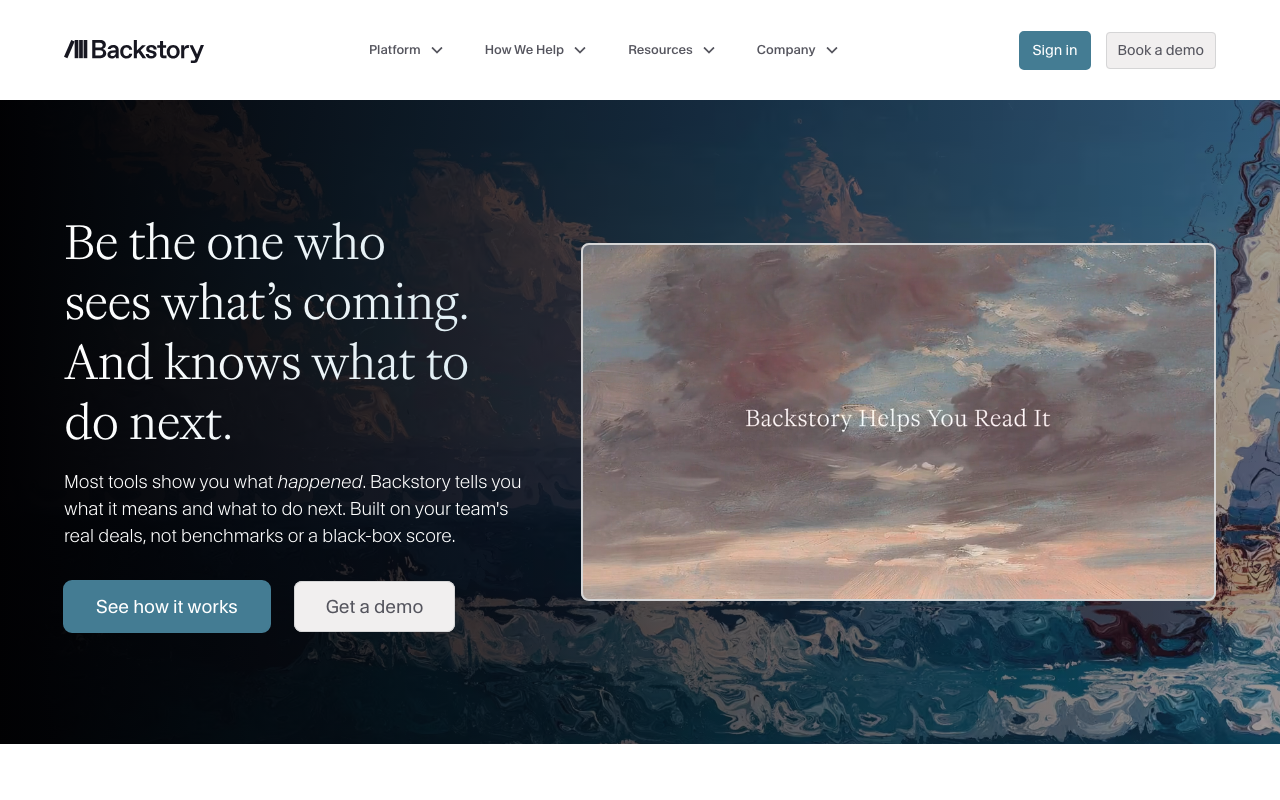
One thing to know going in: in April 2026 People.ai announced it is rebranding to Backstory and repositioning around "revenue answers" rather than dashboards. The underlying engine is the same, so this review still applies, but expect the name and some product framing to shift as you evaluate it.
Activity capture that feeds the rest of the stack
The foundation is automated activity capture. People.ai connects to email, calendar, and meeting tools and logs interactions against the right accounts and opportunities without reps touching anything. That sounds mundane until you remember that incomplete CRM data is the single thing most forecasting tools quietly choke on. People.ai's pitch is that it fixes the input, not just the report. It also backfills history, processing roughly two years of past activity on deployment, so you are not starting from an empty slate.
On top of that capture sits the intelligence layer: deal risk scoring, multi-threading and stakeholder-gap alerts, engagement patterns, and relationship maps that show who on your side is talking to who on theirs. The newer SalesAI assistant turns that into plain-language answers, so a manager can ask why a deal slipped instead of building a report to find out. People.ai backs this with a large proprietary dataset, on the order of a trillion logged activities and well over a hundred million contacts, which is the moat it leans on against newer entrants.
How it compares in the category
The honest comparison is against Clari and Gong, the two names buyers usually shortlist alongside it. Clari is the forecasting heavyweight and Gong owns conversation intelligence. People.ai sits between them, strongest on the capture side, and is usually the more affordable of the three per seat. If forecasting workflow leads, look hard at Clari. If recorded-call analysis is the job, that is Gong's turf. People.ai wins when complete, automatic activity data across the whole funnel is the thing you cannot get any other way.
Where People.ai lands on AI-stack fit
People.ai earns an 84 on CR Buddy's AI-stack-fit score, strong for an enterprise platform. The API story is the strong part. It exposes REST APIs and deep two-way integrations with Salesforce and Microsoft Dynamics, so activity and revenue data can flow in and out of your own systems and an external agent or script can read it programmatically. That is genuinely useful if you want to pull People.ai's enriched activity data into a warehouse or a custom workflow.
The agent-control story is now a real strength. People.ai ships an official MCP connector that lets an assistant like Claude, ChatGPT, or Copilot, or a custom agent, query its revenue intelligence directly across account and deal history plus CRM data. Paired with the REST API, that gives you both agent-native access and programmatic data flow, which is why the score sits near the top of the leaderboard. As the product rebrands to Backstory the MCP connector is documented on the vendor's platform pages, so confirm the current setup steps there if agent-native access matters to your stack.
Pricing notes
People.ai is custom, annual, per-seat pricing. There is no free plan and no self-serve tier, so every deal runs through sales. Publicly tracked contracts land from a few thousand dollars a year for a small footprint into the low six figures for large rollouts, with the typical annual contract reported in the low five figures. What you pay depends on seat count, modules, and data volume.
That puts People.ai at the more affordable end of revenue intelligence, often below Clari and Gong per seat, which is a real point in its favor. Do not treat any published number as a quote. Verify the current structure and get a tailored figure on the vendor's pricing page before you budget.
The verdict
People.ai is a strong choice when your core problem is that nobody trusts the CRM and your forecast rides on data reps never fully enter. The automatic capture is the real product, and the intelligence on top is a credible reason to pick it over a pure forecasting tool. Go in clear-eyed: this is an enterprise commitment with an implementation, and the value scales with team size, so it is overkill for small teams.
Weighing options? Scratchpad is the lighter, cheaper pick for Salesforce hygiene, and Clari is the heavier forecasting platform if that workflow leads your shortlist. See the full best revops roundup for the head-to-head.