

Who Spekit is for
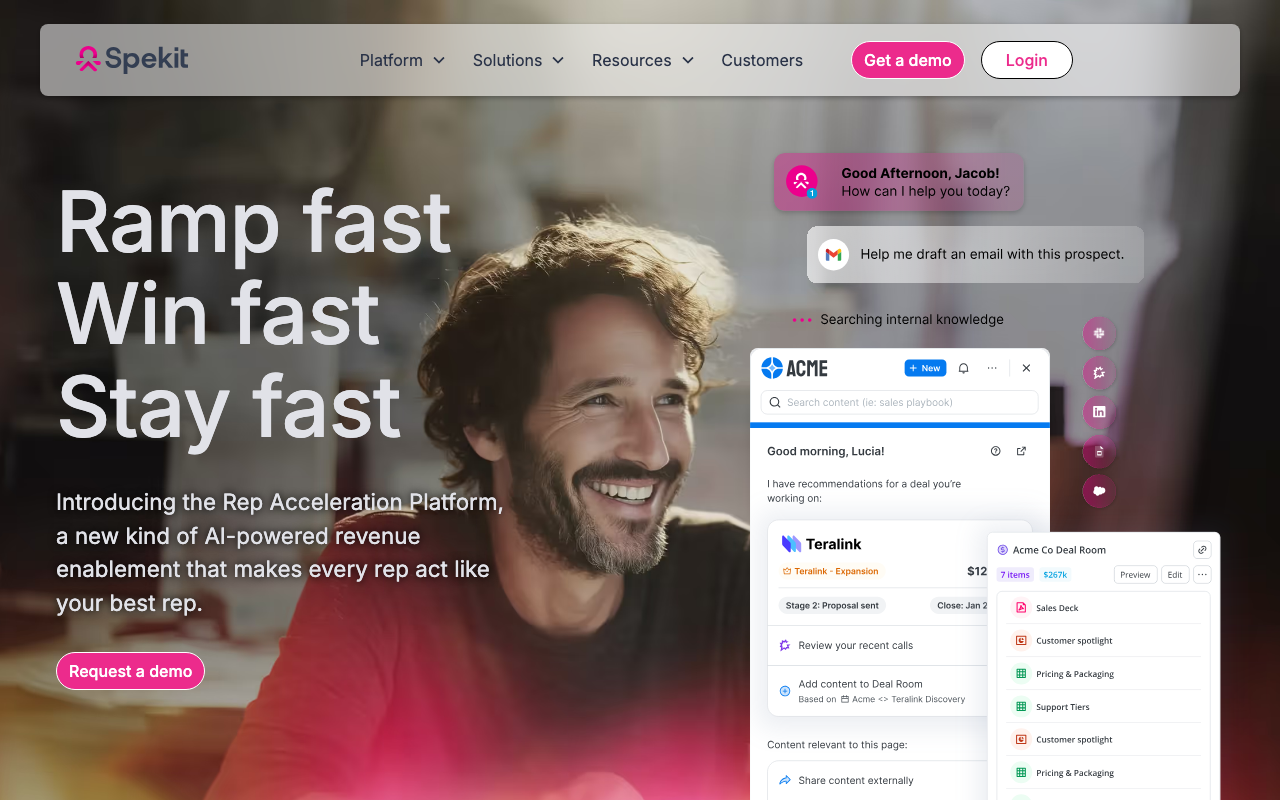
Spekit is for teams whose reps spend their day inside a known set of apps, usually Salesforce, Gmail or Outlook, Chrome, and Slack, and who keep losing time hunting for the right answer mid-deal. The pitch is enablement that comes to the rep instead of the rep going to a content library. If your problem is that playbooks, product facts, and competitive notes live in a wiki nobody opens, Spekit puts that knowledge inside the workflow as on-screen tooltips and an AI assistant, so a rep gets the answer without leaving the screen they are on.
It is a weaker fit if your reps work across a sprawling or unusual tool stack, or if you need a heavyweight content management and analytics suite for a large enablement org. In that case a platform built around a central content hub, like Seismic, gives you more control over governance, distribution, and reporting. Spekit shines when the apps are predictable and the goal is speed at the point of work, not deep library management.
Enablement that surfaces in the flow of work
The core idea is what Spekit calls "Speks," bite-size pieces of knowledge that surface as contextual overlays inside the tools reps use. A rep filling out a Salesforce opportunity field sees the definition and the right process attached to that field. A rep writing an email sees the approved messaging for that stage. Nothing requires a separate tab or a search through a portal, which is the whole point: enablement that appears where the work happens tends to actually get used, and Spekit's high marks on G2 and Capterra (4.7 and 4.8) lean heavily on that ease of use.
Beyond inline tooltips, Spekit runs onboarding and training as learning paths, so new hires ramp inside the same surfaces they will work in rather than in a disconnected LMS. The platform has also moved toward deal context and coaching: it pulls Salesforce opportunity data and Gong call intelligence together so an AI layer, branded AI Sidekick, can offer stage-aware guidance and suggested content while a deal is live. Newer Deal Room features let reps share content with buyer committees and track engagement. That positions Spekit as more than a tooltip tool, though the inline, just-in-time delivery is still the strength buyers consistently name.
Where Spekit lands on AI-stack fit
Spekit earns a 65 AI-stack-fit score from CR Buddy, mid-pack for the sales-enablement category. The AI it ships is genuinely useful to reps in the moment, with the Sidekick assistant generating content and surfacing coaching in context, but that is AI inside the product, not AI that an outside agent can drive.
On the connectivity that matters for an agentic stack, Spekit offers a REST API and the integrations needed to embed content across Salesforce, Chrome, and Slack. What it does not have is a first-party MCP server, so an assistant like Claude or Codex cannot drive Spekit directly the way it can drive an MCP-native tool. If you want your own automation to push content in or read engagement data out, the API and integration layer is the path, and it is workable rather than native. That gap is exactly why Spekit scores solidly without reaching the top of the leaderboard: the in-product AI is real, but programmatic agent control is still second-class.
Pricing notes
Spekit does not publish a price list. The pricing page states that packages are customizable by organization size and use case and routes you to a demo, so plan on a sales conversation and annual, per-seat billing rather than a self-serve sign-up. There is no free plan advertised.
Third-party trackers give you a rough frame. Listings have referenced a lower tier around $10 per user per month and a higher tier near $20 per user per month, with product guides and in-app messaging as paid add-ons, and Vendr has tracked a median annual contract in the mid five figures. Treat those as directional only, not a quote, and verify the current structure on the vendor's pricing page or in your own demo. Two honest caveats worth raising in that call: per-seat pricing scales up quickly as headcount grows, and several reviews note that the better support and a dedicated account manager sit on the higher tier, so a basic plan can feel thin on help.
The verdict
Spekit is a smart way to deliver enablement in the flow of work, and it is at its best when your reps live in a predictable stack centered on Salesforce. If knowledge adoption is your real problem, the inline, just-in-time model genuinely moves the needle on rep behavior, and the AI Sidekick adds useful in-context coaching. Go in knowing that pricing is custom and per-seat, and that the agent-readiness story stops at a REST API with no MCP.
If you want a broader content and governance platform for a larger org, look at Seismic. If budget is tight and your team is smaller, Enablix covers the enablement basics at SMB-friendly pricing. For the full comparison, see the best sales-enablement roundup.