

Who AiSDR is for
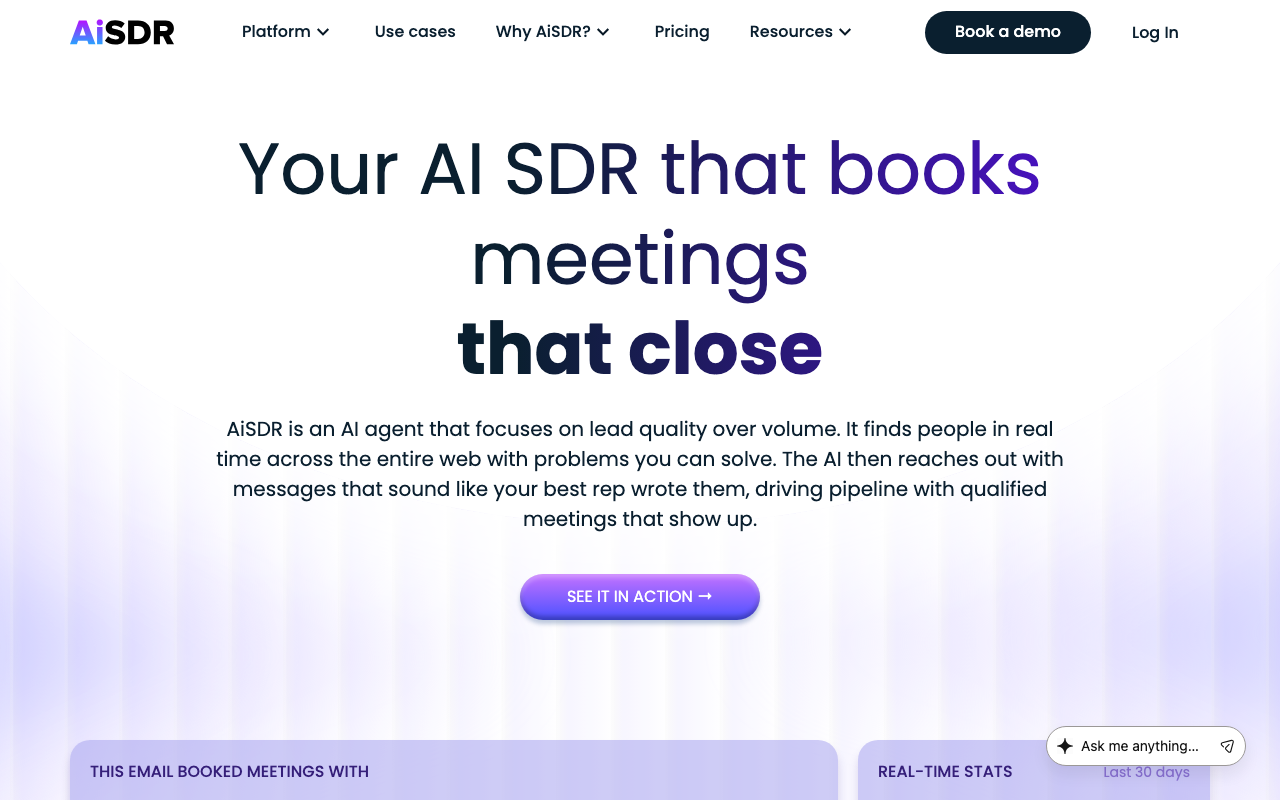
AiSDR is for a small or mid-size team that wants outbound running without hiring and managing a human SDR. You feed it an ICP, connect a mailbox and a LinkedIn account, and it prospects, writes, sends, and handles replies across email and LinkedIn on a schedule. Founders doing their own pipeline, small sales teams without a dedicated outbound hire, and RevOps people who want to test an AI SDR motion cheaply are the core buyers. The flat monthly price and unlimited seats make it easy to put in front of a whole team.
It is a weaker fit if you have a complex, multi-stage qualification process or you live in Salesforce. AiSDR is HubSpot-first, and reviewers consistently flag that sequence customization is thinner than what a power-user team expects. If you want full control over the message logic and CRM depth, an agentic platform you configure yourself like Artisan, or a broader AI prospecting motion like Amplemarket, will frustrate you less.
What AiSDR actually does
AiSDR is an end-to-end outbound assistant rather than a tool you operate step by step. It pulls lead data from a large pool of sources, builds a multi-channel sequence, and personalizes each message using signals like recent job changes, LinkedIn activity, and buyer intent. The sequence builder unites email, LinkedIn DMs and InMail, and call steps into one flow, with adjustable timing and touchpoint counts. You can layer in AI-generated videos, voice notes, and even memes, which lands well for some audiences and feels gimmicky for others, so test before you lean on it.
The part teams value most is reply handling. AiSDR reads inbound responses, answers routine questions, and books meetings on your calendar without a human in the loop. That is the real labor it removes. Onboarding is hands-on: the vendor assigns a GTM engineer and quotes roughly a one-week setup window, which matters because the quality of an autonomous SDR depends heavily on how well its ICP and messaging are configured up front. Get the inputs wrong and you will send polished emails to the wrong people at scale.
Standout strengths and real weaknesses
The strength is genuine autonomy at a fixed price. Many AI SDR tools either need constant babysitting or hide costs behind per-lead charges. AiSDR includes lead generation in the subscription and runs the full loop on its own, which is rare in this category and the reason it scores a solid 7.2 with CR Buddy.
The weakness is output variance. Across published reviews, personalization quality swings with your ICP and the data behind it, and the messaging needs supervision so it does not drift off-brand or send something tone-deaf. AiSDR is also a newer player with a smaller track record than incumbents, so you are betting on a younger product.
Where AiSDR lands on AI-stack fit
AiSDR earns a 44 AI-stack-fit score from CR Buddy. It is genuinely agentic in what it does and runs an autonomous outbound loop, and it connects to HubSpot, Salesforce, Gmail, LinkedIn, Calendly, and Aircall. Those are managed native connectors a GTM engineer wires up during onboarding, not a developer API you control yourself.
The score is held down by two gaps. AiSDR ships no public MCP server, so an assistant like Claude or a Codex-style agent cannot drive it directly the way it can drive an MCP-native CRM. It also exposes no public REST or GraphQL API, so there is no self-serve way to push or pull data programmatically; everything routes through the prebuilt integrations set up at onboarding. That is fine if you only need the supported connectors, but it puts AiSDR in the lower-middle of the leaderboard rather than the top. If programmatic control or native agent access matters to you, confirm the current integration list on the vendor's site before you sign.
Pricing notes
AiSDR uses flat monthly pricing, which is its most attractive commercial feature, but the billing terms deserve attention. Plans are billed quarterly by default, with an annual option at a discount, so the real entry commitment is several months of spend rather than a single month. There is no free plan and no free trial, so you are buying before you see your own results.
The entry tier starts around $900 per month and is built for low volume and a handful of meetings, while the next tier up roughly triples capacity and adds extras like AI video, voice notes, and HubSpot account scoring. Enterprise is custom and adds website visitor tracking and dedicated support. Every tier includes unlimited seats and bundles lead generation into the price. Prices and capacity allowances change, so verify the current numbers and billing period on the vendor's pricing page before committing.
The verdict
AiSDR is a sensible pick if you are an SMB that wants an autonomous, affordable outbound assistant and you live in HubSpot. The flat price, included leads, and hands-on onboarding lower the barrier to trying an AI SDR. Just go in expecting to supervise the messaging closely and to commit for a quarter, not a week.
If you want a configurable agent platform instead, look at Artisan, and if you want a wider all-in-one AI prospecting motion, Amplemarket is worth a look. See the full best ai-sdr roundup for the head-to-head.