

Who Artisan is for
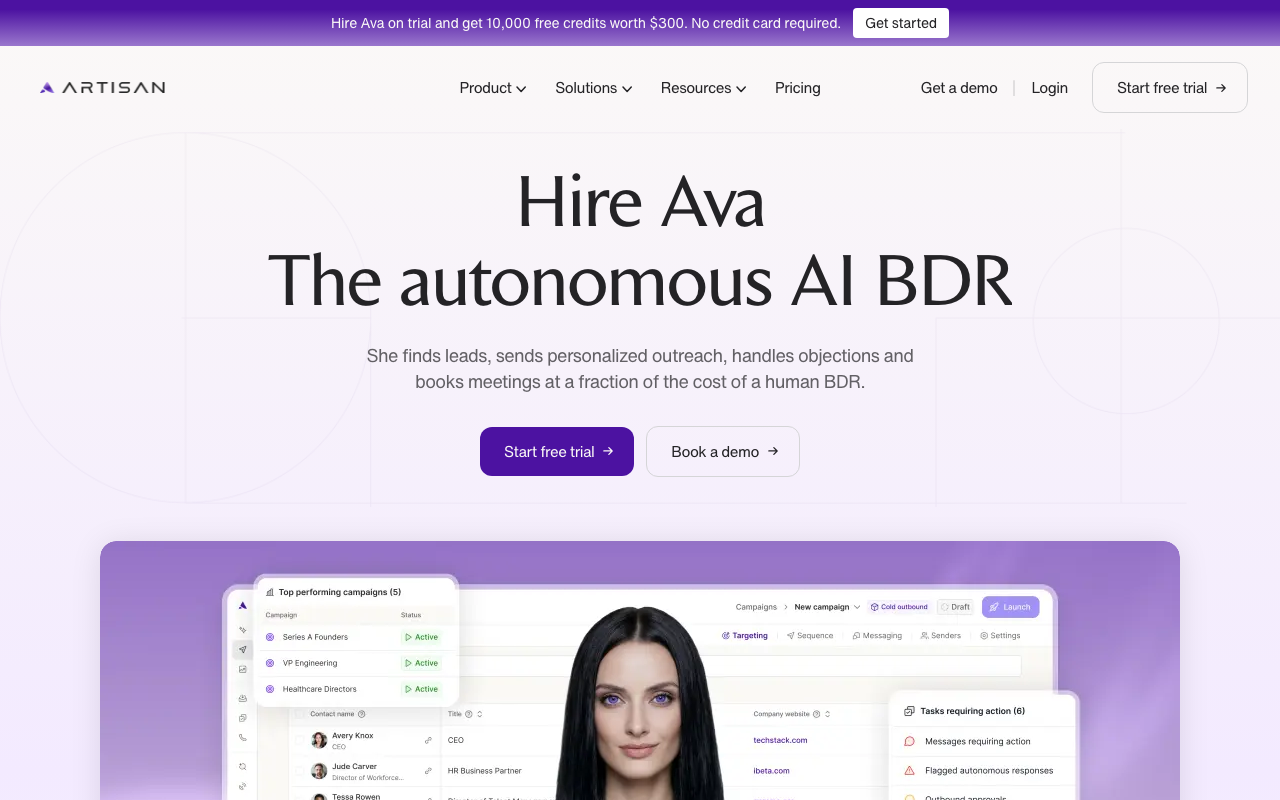
Artisan is for an outbound team that wants one system to own the top of the funnel instead of stitching together a data provider, an enrichment tool, and a sequencer. Its product, an AI BDR named Ava, finds leads, enriches them, writes personalized messages, sends across channels, and handles replies. If you are a founder or a small sales team trying to run real outbound volume without hiring three SDRs, this is the pitch Artisan is built around.
It is a weaker fit if you want a tool you fully drive yourself, or if your motion is inbound rather than cold outbound. Teams that prefer to keep humans writing every message, or that want a self-serve enrichment-and-sequencing stack they control row by row, will be happier with something like Apollo. Artisan asks you to trust an agent with more of the work, and that trust is the whole bet.
What Ava actually does
Ava is an autonomous agent that runs the full prospecting loop. It pulls from a bundled B2B database of over 300 million professionals and 130 million businesses, with waterfall email and phone enrichment that tries 15-plus providers in sequence to lift match rates. From there it researches each prospect, writes personalized copy, and sends. The 2.0 release made Ava genuinely multichannel, adding social outreach and a built-in dialer for warm leads alongside email.
The part that separates Artisan from a plain sequencer is how much it decides on its own. An ML-based lead scoring system ranks prospects by propensity so Ava focuses on the contacts most likely to convert. A dedicated signals layer watches for funding rounds, leadership changes, new hires, and tech stack shifts, then enrolls matching prospects into the right play automatically. There are distinct campaign types for cold outbound, warm outbound, cross-sell and upsell, and signal-triggered workflows.
The 2.0 release also added a conversational interface. You can chat with Ava in natural language to launch campaigns, ask questions, and adjust targeting, which is a more honest version of "AI-native" than most tools in this category ship. The flip side is the one CRB keeps flagging across AI SDRs: autonomous output still needs human guardrails. Left fully unattended, an agent sending at volume can burn domain reputation and send off-key copy, so plan to review messaging and watch deliverability rather than set it and walk away.
Where Artisan lands on AI-stack fit
Artisan earns a 50 AI-stack-fit score, which sits in the middle of the pack. The product is agentic by design, not bolted on: Ava bundles its own data, runs research, and acts on signals without you wiring up a separate pipeline, and the conversational control surface reinforces that. But agentic from the inside is not the same as agent-connectable from the outside, which is where the score gets capped.
The reason it does not score higher is that Artisan has no external agent surface. There is no public MCP server, so an assistant like Claude or Codex cannot drive Ava directly. There is also no documented public API: Artisan connects through native integrations with Salesforce, HubSpot, Slack, Gmail, Outlook, and LinkedIn rather than exposing developer endpoints you can call. If your stack is built around assistants orchestrating tools through MCP or custom code hitting an API, you will be limited to those prebuilt integrations rather than piloting Artisan programmatically.
Pricing notes
Artisan's pricing changed a lot with Ava 2.0. It moved from a roughly $2,500-a-month sales-led contract to a self-serve, credit-based model starting around $250 a month, which is a major shift worth knowing before you read older reviews. Credits power everything Ava does: finding and enriching leads, personalizing outreach, and handling replies, so two teams on the same plan can spend very differently depending on volume and how much phone enrichment they use.
There is a free plan with 300 credits a month for lead discovery and enrichment and no card required. From there the paid tiers are Intern at $250 a month and Employee at $600 a month, both billed annually, with Enterprise on custom pricing. Paid tiers step up the credit allocation and unlock autonomous campaigns and CRM integrations, and Enterprise adds SSO, security controls, and dedicated support. Annual billing fronts your full credit allocation. Credit usage varies a lot by volume and how much phone enrichment you run, so confirm current credit costs and what each tier unlocks on Artisan's pricing page before you commit.
The verdict
Artisan is one of the strongest AI BDRs available right now. The bundled data, signal-triggered campaigns, and multichannel sending make it a credible way to run outbound without a large SDR bench, and the move to self-serve credit pricing makes it far easier to try than it was a year ago. Go in treating Ava as a fast junior rep, not an autopilot: review the copy, watch deliverability, and keep a human owning the strategy.
Shopping the category? 11x is the closest head-to-head if you want to compare autonomous SDRs, and Apollo is the better pick if you would rather drive enrichment and sequencing yourself. See the full best ai-sdr roundup for the comparison.