

Who Bardeen is for
Bardeen is for the rep or ops person who keeps doing the same web-and-CRM chores by hand: scrape a LinkedIn list, enrich the contacts, push them into HubSpot, repeat. If your day is full of copy-paste between a browser tab and a CRM, Bardeen turns those steps into reusable automations called Playbooks, and you do not need to write code to build them. SDRs, AEs, RevOps people, and solo founders who live in the browser get the most out of it.
It is a weaker fit if you want to build a large, durable prospecting system that runs on a schedule against clean APIs. Bardeen's actions often drive the actual web page, which is flexible but more fragile than API-first tooling. If list-building and enrichment at scale is the hard part of your job, Clay is the stronger engine, with waterfall enrichment across 100-plus data providers and a structured table model. Bardeen wins when the work is browser-shaped and you want to automate it fast.
What Bardeen actually does
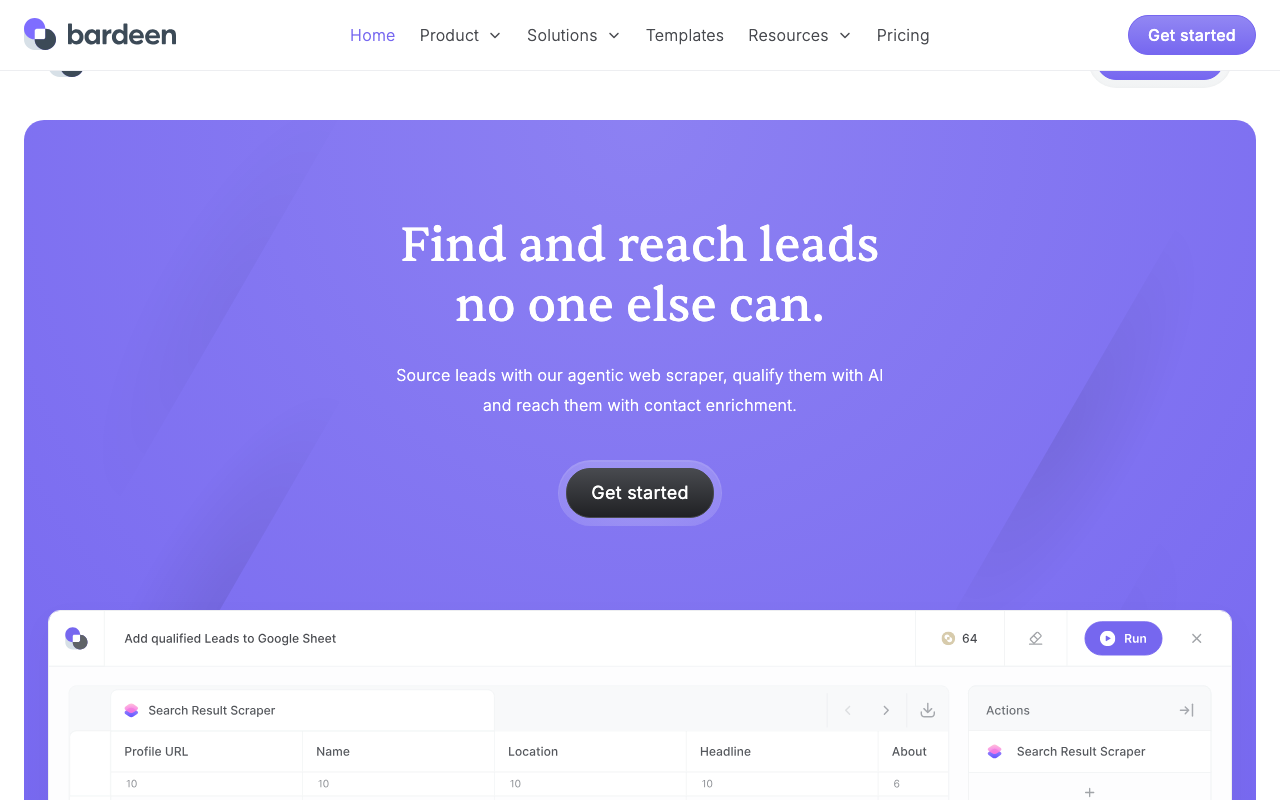
The core of Bardeen is browser-native automation. It runs as a Chrome extension and can act on the pages you already visit, including sites that expose no public API. That is the trick behind its scraping: it can pull data from a LinkedIn search, a directory, or an internal tool the way you would by clicking through it, then drop the results into Google Sheets, Airtable, Notion, or a CRM. Bardeen describes scraping as its headline strength, and it ships a large library of prebuilt premium scrapers so you are not starting from scratch.
On top of scraping sit three things reps care about. Enrichment adds validated emails and phone numbers to the contacts you collect. AI search and qualification let you describe an ideal prospect in plain language and have Bardeen prioritize or research leads using web search and large language models. And the Magic Box lets you type what you want in plain English and get a working Playbook back, which lowers the barrier for people who would never touch Zapier.
Agent mode and chaining tasks
The more interesting recent direction is Bardeen's agent mode, which chains tasks across apps rather than running one trigger-action recipe. You can set up a flow that finds accounts matching a signal, enriches the people on them, runs an AI research pass, and writes the output into your CRM, all from one instruction. This is where Bardeen earns the "AI SDR" framing: it does the busywork between research and outreach, not just a single scrape.
The honest caveat is reliability. Because many actions touch the live web page, layout changes, login walls, and rate limits can break a Playbook that worked last week. Lighter automations are dependable. Heavier multi-step flows take tuning and the occasional repair, so treat Bardeen as something you maintain, not set-and-forget.
Where Bardeen lands on AI-stack fit
Bardeen earns a 75 AI-stack-fit score from CR Buddy, which puts it solidly mid-pack in the ai-sdr category. The reasoning is twofold. On the plus side, Bardeen is genuinely agentic in concept: agent mode reasons across apps, it taps OpenAI and web-search providers for research, and it connects to HubSpot, Salesforce, and the wider Zapier and Make ecosystem. It is built to act, which is the spirit of an agent-ready tool.
What holds the score back is external controllability. Bardeen has no public MCP server, so an assistant like Claude cannot drive it directly the way it can drive an MCP-native CRM. Control from outside runs through Bardeen's REST API and its integration layer instead. That works, and it is a step behind tools that ship MCP and let an agent operate them natively. The browser-execution model is also a double-edged sword for agent fit: it unlocks sites with no API, but it makes flows less deterministic than pure API calls, which matters when you want an agent to run something unattended. So Bardeen scores well for being action-oriented, and not at the top because the cleanest agent control is not there yet.
Pricing notes
Bardeen has a free tier (100 credits per month) and runs on a credit model, so cost tracks usage rather than seats alone. Every action row generally costs one credit and enrichment rows cost more, with a monthly free credit allowance that resets and expires each period. The cheapest paid plan is Basic at $10 per month on monthly billing, and Premium runs $50 per month or $480 per year on annual billing, stepping up the credit allotment and unlocking premium scrapers, enrichment, and team features. A custom Enterprise tier adds scrapers Bardeen builds and maintains for you plus priority support. Verify the current prices, credit allowances, and billing period on Bardeen's pricing page before you commit, since the tiers do shift. The practical watch-out is the same as any credit tool: a flow that enriches every row will burn credits faster than you expect.
The verdict
Bardeen is a useful automation layer that removes a lot of manual prospecting work, especially for reps who want browser-shaped chores handled without learning a heavyweight platform. Go in expecting to tune and occasionally repair the more ambitious flows, and to mind your credit consumption.
If you need a deeper list-building and enrichment engine, Clay is the stronger pick, and Apollo is the better all-in-one if you want a database, enrichment, and sequencing in one place. See the full best ai-sdr roundup for the head-to-head.