

Who Clay is for
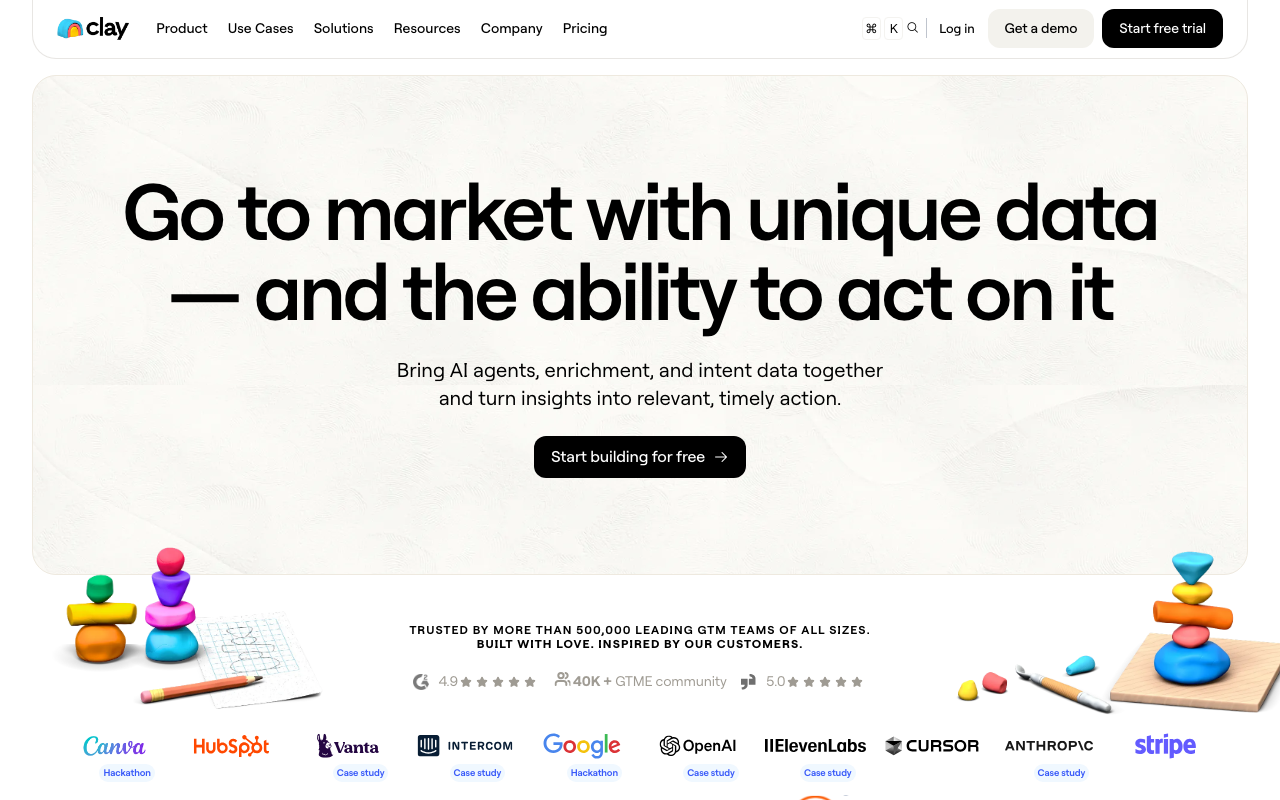
Clay is for the person who wants to build a prospecting system, not just run a sequence. If you think in terms of "find accounts matching this signal, enrich the right contacts, research each one, then hand a clean list to outreach," Clay is the strongest tool on the market for that job. GTM engineers, RevOps people, and ops-minded founders get the most out of it.
It is a worse fit if you want something turnkey. Clay is a power tool with a real learning curve, and the credit-based pricing rewards people who understand what each enrichment step costs. A solo AE who just wants verified emails and a sequence will get there faster, and cheaper, with an all-in-one like Apollo. Clay pays off when the list-building itself is the hard part.
A spreadsheet that runs your research
The core of Clay is a table. Each row is a company or a person, and each column is an action: pull from a data provider, call an AI model, hit an API, branch on a condition. You build a workflow once and run it across thousands of rows. That structure is why GTM teams describe Clay as their prospecting operating system rather than a single tool.
Two features carry most of the value. The first is waterfall enrichment. Instead of trusting one data vendor for an email or phone number, Clay tries them in sequence: if the first provider has no match, it falls through to the next, and the next. Across 100-plus integrated providers, that pushes email match rates well past what any single source delivers on its own, which is the whole reason people tolerate the complexity.
The second is Claygent, Clay's AI research agent. Claygent can read a company website, scan job postings, summarize recent news, or pull a specific data point that no structured provider sells, then return it as clean text in a column. This is the part that feels genuinely AI-native: you write a prompt once, and it runs custom research on every account in the list. Pair it with the newer Sculptor assistant for building tables from a plain-language brief, and a lot of the old "stare at the blank table" friction goes away.
Why it scores high on AI-stack fit
Clay earns its 87 AI-stack-fit score by being AI-native in the workflow and controllable from the outside. You can call Claude or GPT on any row, feed them enriched data, and use the output to drive the next step. That is closer to how an agent actually works than most "AI features" in this category.
Control from the outside is now first-class too. Clay ships a first-party MCP server at clay.com/mcp, a 21-tool GTM server that connects Claude, ChatGPT, and Codex, so an assistant can drive Clay directly rather than only through code. On top of that, Clay exposes an Enterprise-tier REST HTTP API for People and Company lookups plus webhooks on its higher plans, so your own code can push rows in and read results out. The combination of an official MCP server and a REST API is exactly why Clay scores near the top of the leaderboard.
Pricing notes
Clay's pricing is its most-discussed weakness, and the reason is credits. Every enrichment action and AI call burns credits, so two teams on the same plan can have very different bills depending on how their workflows are built. A poorly designed table that enriches every row through five providers will drain credits fast.
The free plan is genuinely useful for learning the tool, with a few hundred actions and a small monthly credit allowance, plus unlimited seats. Paid plans step up the credits and unlock the features that matter for automation: phone enrichment and signals on the entry paid tier, and crucially the HTTP API, webhooks, and CRM auto-sync on the Growth tier and above. If you need Clay to talk to the rest of your stack programmatically, budget for Growth, not the cheapest paid plan. Clay also bills annually for the headline rates and charges more month to month, and the tiers have been renamed more than once, so check the current numbers and credit allowances on Clay's pricing page before you commit.
The verdict
If you are serious about AI-driven outbound, Clay is close to essential. Nothing else combines waterfall enrichment, 100-plus providers, and prompt-based research in one place this cleanly. Go in knowing it is a build-it-yourself power tool: plan to invest time learning it, and watch your credit consumption like a budget line.
Looking at alternatives? Apollo is the better pick if you want enrichment and sequencing in one turnkey platform, and Amplemarket leans more toward an all-in-one AI prospecting motion. See the full best prospecting software roundup for the head-to-head.