

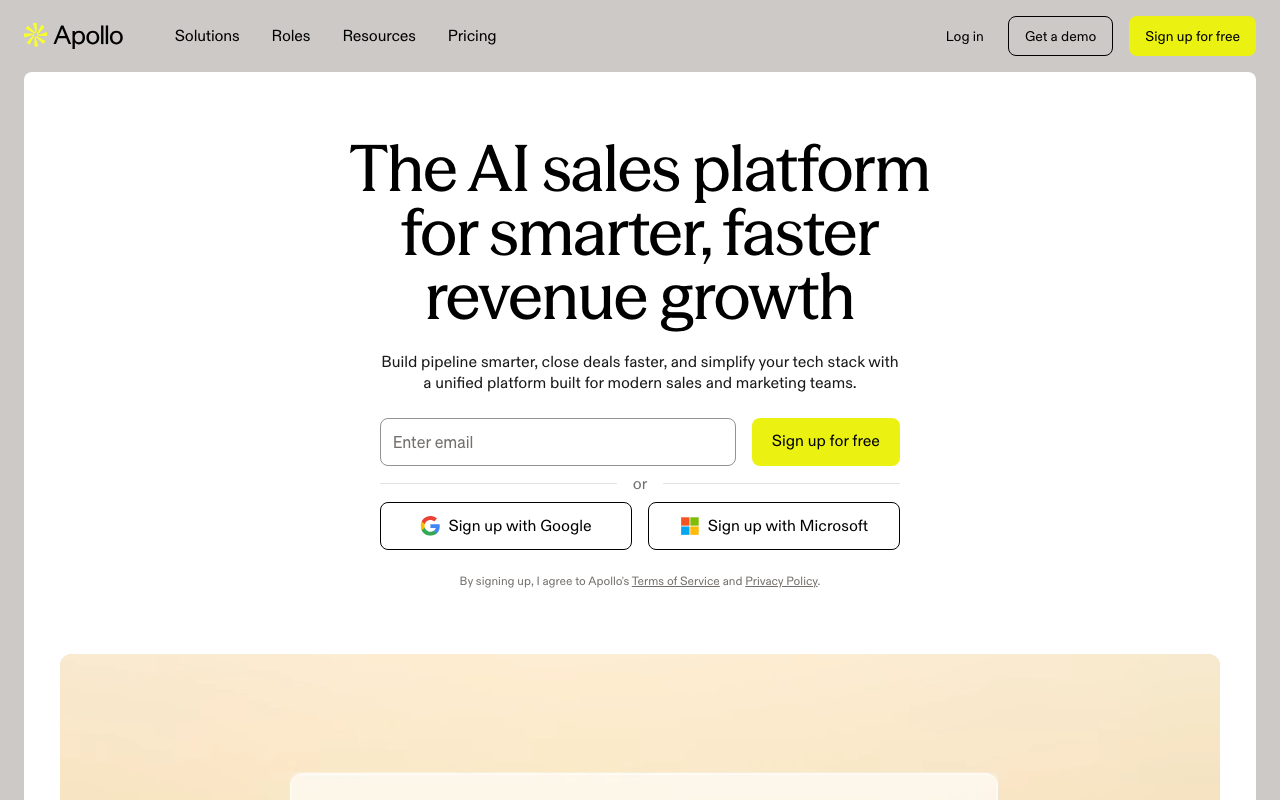
Who Apollo.io is for
Apollo.io is for founders, solo AEs, and small sales teams who want to find contacts and email them from the same tool, without paying for a separate database and a separate sequencer. If your budget is tight and your motion is "build a list, run a sequence, book a meeting," Apollo covers the whole loop at a price that is hard to argue with. Its aggressive free plan also makes it the natural first stop for anyone testing outbound before committing real money.
It is a weaker fit if data quality is your bottleneck, especially in EMEA or for senior, hard-to-reach contacts. Apollo is broad rather than best-in-class at any one thing, so a team that needs the cleanest possible enrichment will get better match rates routing through a waterfall tool like Clay. Enterprise buyers who live on phone data may also find the mobile numbers too hit-or-miss to rely on.
A database and an engagement engine in one tool
The core pitch is two products stitched together. The first is a B2B database of more than 200 million contacts and roughly 30 million companies, searchable by job title, company size, industry, location, tech stack, and buying-intent signals. The second is an outreach engine: multi-step sequences that mix email, LinkedIn tasks, calls, and manual steps, plus a dialer and basic deal tracking. Most competitors sell one or the other. Apollo's whole reason to exist is that you do not have to glue them together yourself.
That bundling is the real strength. You can filter the database down to an ICP, push the matching contacts straight into a sequence, and start sending without an export, a CSV cleanup, or a second subscription. For a small team, that saved step is worth a lot. The intent signals and the Chrome extension that enriches LinkedIn profiles on the fly round out a workflow that feels complete rather than assembled.
The honest caveat is accuracy. User reports across G2, Capterra, and Reddit put real-world email bounce rates somewhere in the 15 to 35 percent range depending on geography, and one third-party test found mobile-number accuracy near 55 percent. US tech and SaaS contacts tend to be the most reliable. International data, and EMEA in particular, is where Apollo's coverage thins out. None of this makes the data unusable, but you should warm your domains, verify before big sends, and treat the headline contact counts as a ceiling, not a guarantee.
Where Apollo.io lands on AI-stack fit
Apollo scores 85 on CR Buddy's AI-stack-fit scale, which lands it in the top "agent-ready" tier. The backbone is a documented REST API that exposes search, enrichment, and sequence actions. An agent or your own code can query the database, enrich a record, and drop contacts into a sequence programmatically, which is exactly the kind of building block you want when wiring Apollo into Clay, Zapier, Make, or a custom prospecting script. The main friction is rate limits, which bite on large pulls, and the fact that the deeper API tiers are gated behind the higher plans.
On the MCP front, Apollo now ships its own official Model Context Protocol server (Apollo MCP), documented at apollo.io/product/mcp. It exposes around 45 tools and connects to Claude, ChatGPT, and Perplexity over OAuth, and it is available on every plan including the free tier. That means an assistant like Claude Code or ChatGPT can search the database, enrich records, and run sequence actions natively in a conversation, no custom wrapper required. Community MCP servers that wrap the REST API also exist, but Apollo's first-party server is the authoritative path. The REST API stays the dependable option for code you control. CR Buddy has not hands-on tested the connector.
Pricing notes
Apollo runs four tiers: a Free plan, then Basic, Professional, and Organization, all priced per user. Headline rates start around $49 per user per month on Basic, climbing through roughly $79 on Professional to about $119 on Organization, with those numbers reflecting annual billing. Paying monthly costs more, and per-seat pricing means the bill scales with headcount, so a five-person team is doing real math here. Verify current numbers on Apollo's pricing page before you commit, since the tiers and credit allowances change.
The thing to understand is credits. Email, export, and especially mobile-number lookups consume credits, phone data costs far more per lookup than email, and credits reset each billing cycle rather than rolling over. Overages are billed separately. The free plan is generous enough to genuinely test the product, Basic removes sequence limits and adds intent, Professional adds AI assist and dialer minutes, and Organization unlocks advanced security, call transcripts, and the deeper API access, with a minimum seat count. Budget by how many enrichments you will actually run, not by the sticker price alone.
The verdict
Apollo.io is the best value entry point for outbound when budget is tight. For a founder or a small team that wants find-and-reach in one place, nothing else matches the combination of a large database, built-in sequencing, a real API, and a free plan you can start on today. Go in with clear eyes about data accuracy outside US tech, and verify before you send at volume.
If clean enrichment matters more than all-in-one convenience, Clay is the stronger engine, and Amplemarket leans into a more AI-driven all-in-one prospecting motion. For the full head-to-head, see the best prospecting roundup.


