

Who HubSpot Sales Hub is for
HubSpot Sales Hub is for teams that want one platform to run sales, marketing, and service, backed by a vendor that is not going anywhere. If you expect to grow from a five-person sales team into something with a marketing function, a support queue, and a real ops practice, HubSpot is the default for a reason. The free CRM is genuinely usable, the data model is clean, and the integration marketplace covers almost anything you will plug in later.
It is a worse fit if you live on the phone and want a tight, opinionated workflow without paying for breadth you will not use. A high-velocity inside-sales team is often happier and cheaper on Close, which builds calling and SMS into the core. And if you want a simple, visual deal pipeline without the platform ambitions, Pipedrive gets reps productive faster. HubSpot pays off when the all-in-one platform itself is the point.
What HubSpot Sales Hub actually does
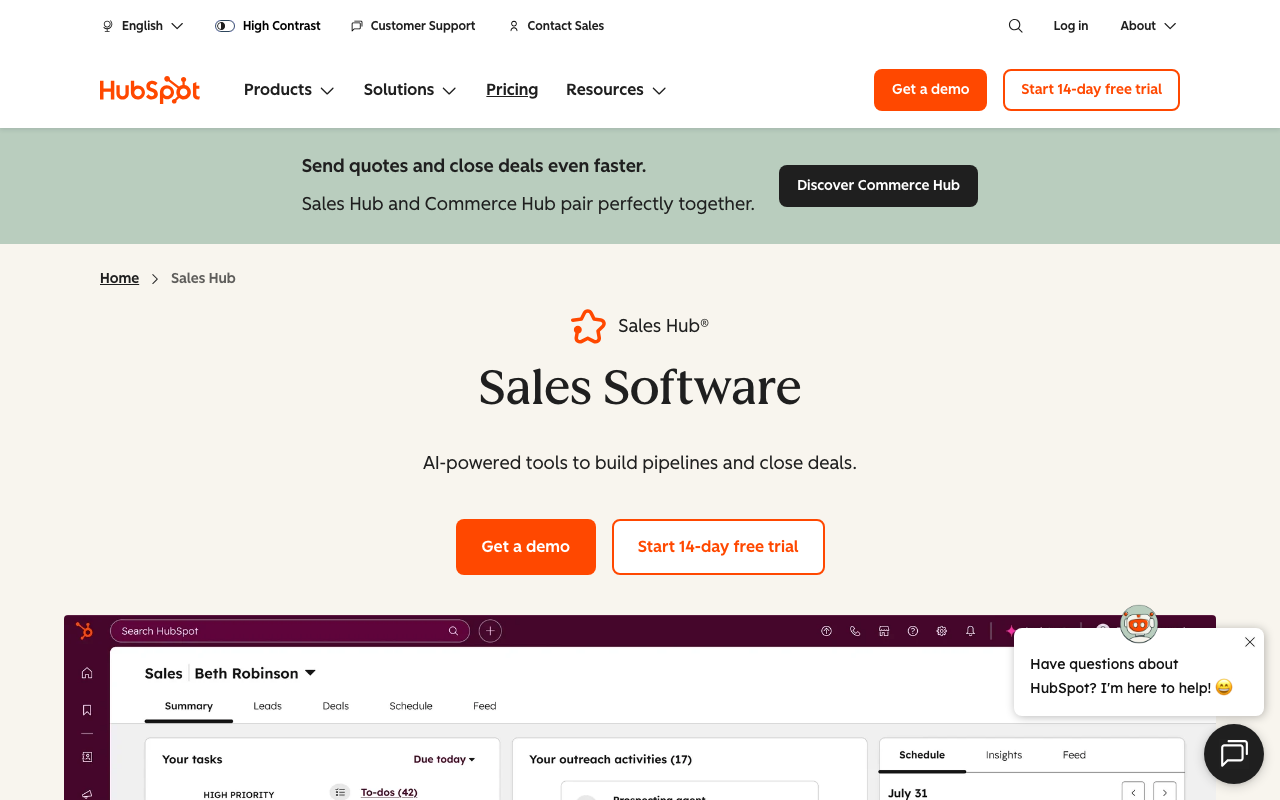
The core is a CRM with contact and company records, a customizable deal pipeline, and the engagement tools reps use day to day: email tracking, meeting scheduling, document tracking, a power dialer with call recording, and quotes. On paid tiers you get sequences for multi-step outreach, deal forecasting, custom reporting, and playbooks. Conversation intelligence transcribes calls and surfaces coaching insights, so a manager can review pipeline and rep activity without leaving the platform.
The strength that keeps HubSpot at the top of shortlists is connectedness. Because Sales Hub shares one record system with Marketing Hub, Service Hub, and the rest of the suite, a lead a marketer captures, a deal a rep closes, and a ticket a support agent opens all sit on the same contact. You do not stitch that together with middleware. For a team that wants marketing and sales reporting to agree on the same numbers, that single source of truth is the real product.
Standout strengths
Two things separate HubSpot from a generic CRM. First, the ecosystem. The marketplace runs to well over a thousand integrations, and most tools a sales team touches ship a native HubSpot connector before they build for smaller CRMs. Second, the API. HubSpot's REST API is mature, well-documented, and stable, which means custom syncs, internal tooling, and automation through Zapier or Make are low-risk to build and maintain. That combination is why HubSpot rarely becomes the thing you have to rip out later.
Where HubSpot Sales Hub lands on AI-stack fit
HubSpot earns its 85 AI-stack-fit score on the strength of its official MCP server, a mature API, and a fast-improving agent story. The REST API has long been the reliable way for an external agent or your own code to read deals, write engagements, and trigger workflows, and that systematic, recurring automation still runs cleanly through it.
The bigger change is on the agent side. HubSpot now ships a hosted remote MCP server that any MCP client, including Claude, ChatGPT, Gemini, and Copilot, can connect to over OAuth to read, search, and act on CRM data in natural language. There is also a developer MCP server aimed at coding tools like Claude Code and Cursor. Native Breeze agents (prospecting, customer-facing, and custom agents built in Breeze Studio) sit on top of the same plumbing. The practical split is clean: MCP for conversational, exploratory work like pipeline analysis and meeting prep, the REST API for scheduled syncs and webhooks. That is a stronger agent posture than most CRMs, and it is improving quickly, so treat 85 as a floor rather than a ceiling here.
Pricing notes
HubSpot's pricing is the part to study before you commit. There are four tiers: Free, Starter, Professional, and Enterprise, charged per seat. Free is a real CRM with no seat cap. Starter sits in the low double digits per seat per month and removes branding and limits while adding light automation. The jump that catches teams off guard is Professional, which is several times the Starter price and is where sequences, forecasting, custom reporting, and full automation actually live. Professional and Enterprise also carry a mandatory one-time onboarding fee in year one, which is easy to miss when you budget.
Annual billing earns the headline rates, and monthly costs more. Costs escalate fast once you add seats or layer in Marketing Hub alongside Sales Hub. HubSpot revises packaging and seat models regularly, so verify the current per-seat numbers, the onboarding fees, and exactly which features sit on each tier on the vendor's pricing page before you sign.
The verdict
HubSpot Sales Hub is the safe, capable choice, and the agent tooling now makes it genuinely interesting rather than just dependable. If you want one platform that will scale across teams and not get ripped out in two years, it is hard to argue against. Go in with eyes open about the Starter-to-Professional cliff and the onboarding fees, and model your real seat count first.
If a tighter workflow matters more than breadth, weigh Close for phone-heavy teams or Pipedrive for a simpler pipeline. See the full best crm roundup for the head-to-head.