

Who QuickMail is for
QuickMail is for the person who treats deliverability as the whole game. If you run cold email at volume across many inboxes, watch reply rates per sender, and care more about whether mail lands than about a pretty interface, QuickMail fits. It has been built around this job for over a decade, and it shows: inbox rotation, native warmup, and per-inbox analytics are first-class, not add-ons. Agencies are the clearest buyer, since higher tiers support multiple client workspaces and unlimited senders with no per-seat charge.
It is a weaker fit if you want an all-in-one that finds the leads for you. QuickMail is a sending engine, not a data provider, so you bring your own list or pair it with something like Clay or Apollo. If you want lead data and sequencing bundled together, look at Instantly, which leans more turnkey for solo senders and small teams. QuickMail rewards people who already have a list and a process and just need it delivered cleanly.
A sending engine built around deliverability
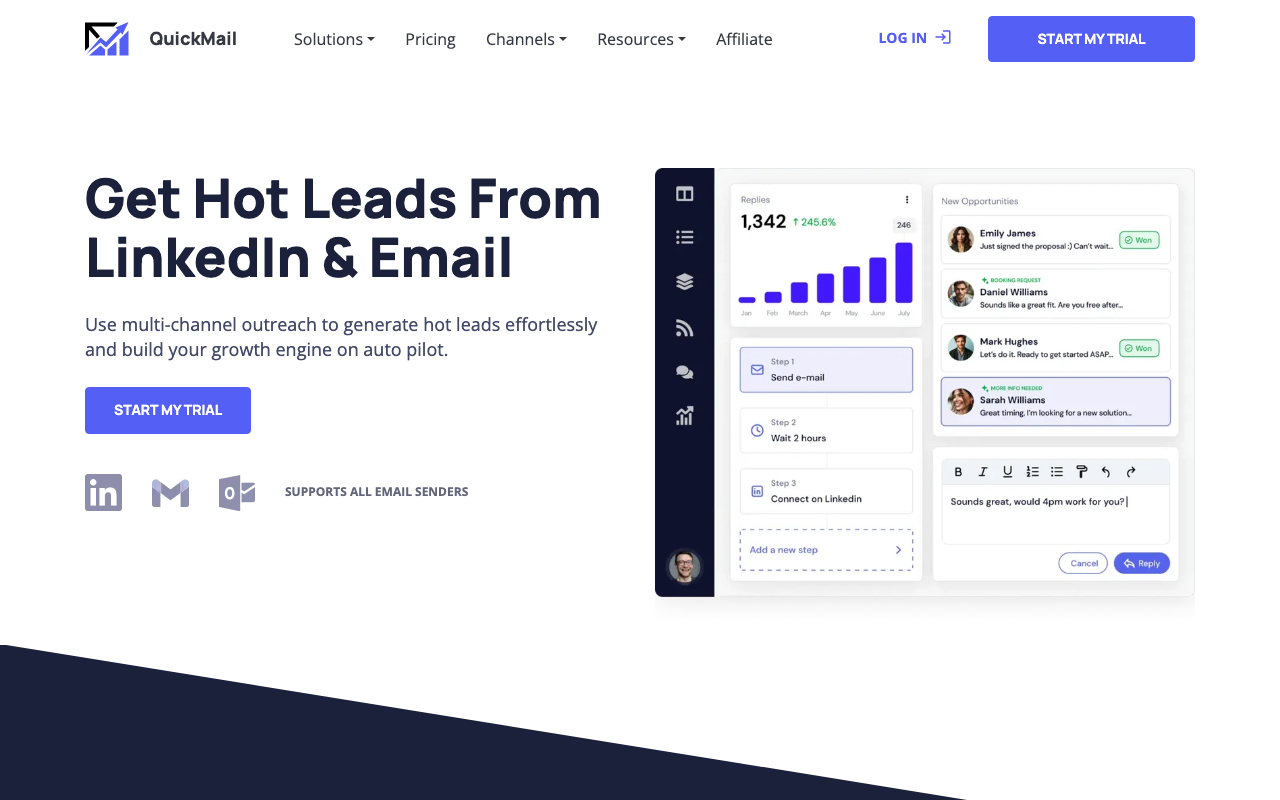
The core of QuickMail is multichannel sequencing across email and LinkedIn, run through your own connected inboxes. Instead of routing mail through shared sending servers, QuickMail sends through your existing Gmail or Outlook accounts via their official APIs, so messages carry your domain, IP, and reputation. That design choice is the reason deliverability-focused senders pick it.
Two features carry most of the value. The first is inbox rotation. You connect multiple sending accounts to a single campaign, and QuickMail spreads volume across them so no one inbox gets hammered, which protects sender reputation as you scale. The second is MailFlow, the built-in warmup tool. Warmup is included free for a meaningful number of inboxes, which matters because standalone warmup services often charge $20 to $30 per inbox per month. For an agency running dozens of senders, that adds up fast.
The analytics deserve a mention too. QuickMail breaks performance down to the individual inbox, so you can see which specific sending account is dragging a campaign and pause or fix it before it poisons the rest. Most cold email tools report at the campaign level and hide this. Reply detection and automatic sequence pausing on a reply round out a feature set that is squarely aimed at people sending real volume, not a few dozen emails a week.
Where QuickMail lands on AI-stack fit
QuickMail earns a 65 AI-stack-fit score on the CR Buddy leaderboard, which is mid-pack for cold outreach. The reason is simple: the integration story is solid but conventional. QuickMail exposes a public GraphQL API with API-key auth, plus webhooks, so your own code, or an external agent, can push prospects into campaigns, read reply and event data back out, and trigger downstream actions. That is enough to wire QuickMail into a larger automated GTM motion, and it connects cleanly to Clay, Zapier or Make, and HubSpot for the plumbing.
What holds the score back is the lack of a first-party MCP server. An assistant like Claude or a Codex agent cannot drive QuickMail directly the way it can drive an MCP-native tool. For now, agent control runs through the GraphQL API and webhook layer, which means you write integration code rather than letting an assistant call the product natively. That is workable and matches most of the cold-outreach category, but it is a step behind the handful of tools shipping MCP. If native agent control is a hard requirement, know that QuickMail is API-first, not agent-first, today.
Pricing notes
QuickMail's pricing is tiered by sending volume and uploaded contacts rather than seats, and every plan includes unlimited users and unlimited connected senders. The live pricing page shows three plans billed monthly: Starter at $49/mo, Growth at $99/mo, and Agency at $299/mo. The Starter tier covers a modest monthly send volume and a small contact list, Growth steps volume up sharply and unlocks API access, and Agency adds high volume, multiple workspaces, webhooks, and priority support. Additional workspaces on the agency plan cost extra, which is worth modeling if you manage many clients.
Two caveats. First, because pricing is tied to active prospects and sends, your real cost depends on how aggressively you scale, and volume limits per tier change with restructures. Second, some third-party aggregators list a cheaper plan that is not on the live vendor page, so do not anchor on a number you read elsewhere. Verify the current tiers, billing period, and limits on QuickMail's pricing page before you commit. All paid plans run on a 14-day free trial that requires a card, with no permanent free plan.
The verdict
QuickMail is a deliverability-minded workhorse for high-volume senders and agencies, and the free MailFlow warmup plus inbox rotation make it genuinely cost-effective at scale. The interface is utilitarian and the pricing is volume-linked, so it suits operators who know what they are doing more than first-timers. On AI-stack fit it is competent through its GraphQL API but not agent-native, which keeps the score in the middle of the pack.
If deliverability at volume is your priority, QuickMail is a strong pick. If you want a slicker all-in-one, compare Instantly, and if you care most about scaling sender infrastructure with AI-assisted sending, look at Smartlead. See the full best cold-outreach roundup for the head-to-head.