

Who Avoma is for
Avoma is for the SMB or mid-market revenue team that wants conversation intelligence without writing an enterprise check. If you lead a sales org of 5 to 100 reps and you want call recording, AI notes, coaching scorecards, and deal tracking in one subscription, Avoma covers more ground per seat than almost anything else in the category. RevOps people who want CRM auto-sync and managers who run weekly coaching get the most out of it.
It is a weaker fit at the top of the market. If you need the deepest call analytics, the largest pattern library across thousands of reps, or buying-committee tracking that survives a complex enterprise deal cycle, Gong is still the deeper platform and the data shows Avoma's analytics trailing it. And if you only want a clean meeting recorder with a free tier and no sales-coaching layer at all, a lighter tool like Fathom will feel simpler and cost less.
A meeting assistant that grew into a revenue platform
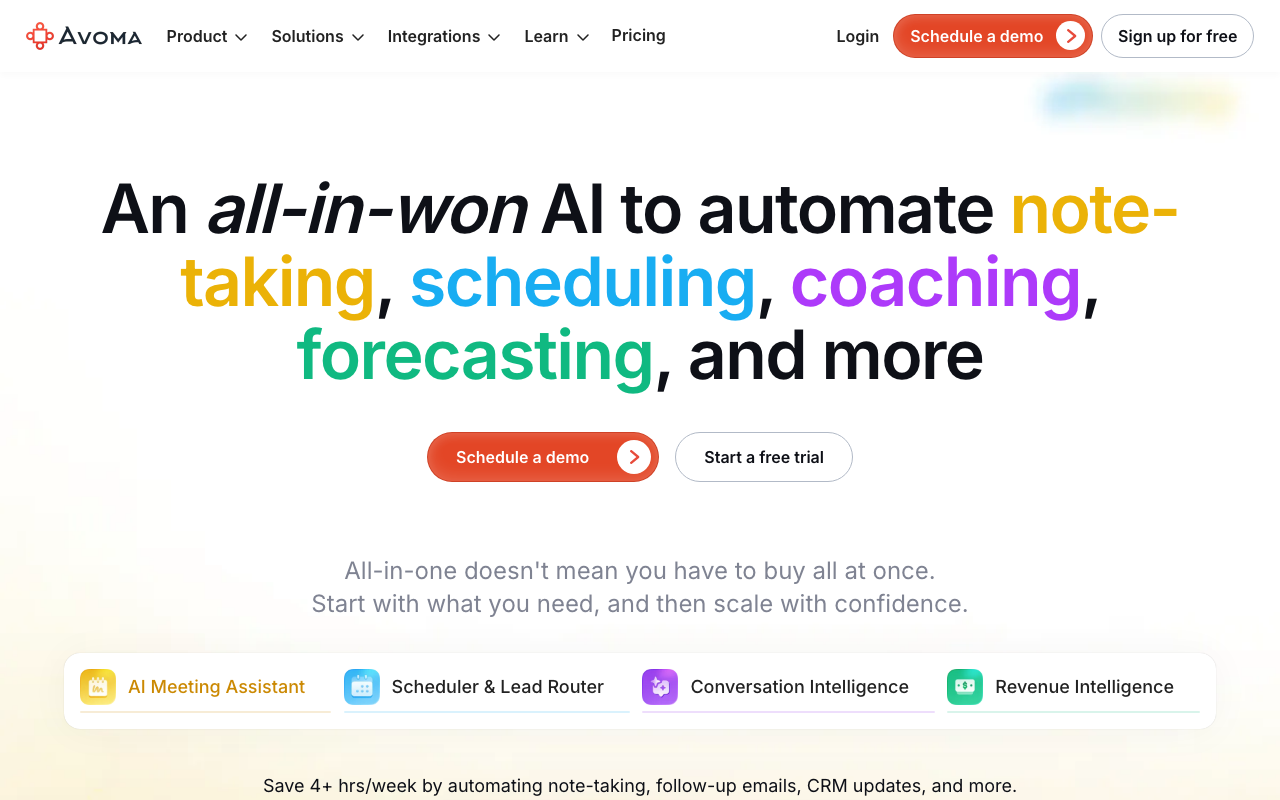
Avoma started as an AI meeting assistant and the notetaker is still the core. It joins your calls on Zoom, Meet, or Teams, records and transcribes them, and produces structured AI notes broken out by topic rather than one wall of text. "Ask Avoma" lets you query a single meeting or your whole history in plain language, and AI email follow-ups draft the recap so reps are not retyping next steps after every call. All of that, plus 1:1 scheduling and CRM auto-save, sits in the base subscription.
The reason Avoma reads as a platform and not just a recorder is the layer above the notes. Conversation intelligence adds call scoring, custom scorecards for frameworks like MEDDICC, SPICED, and Sandler, keyword and topic trackers, and coaching dashboards that show talk ratios and skills across the team. Revenue intelligence adds a deal board, deal-risk alerts, health scoring, forecasting, and win-loss analysis with two-way CRM field updates. A separate lead-router add-on handles inbound qualification and round-robin scheduling. The breadth is the selling point: one vendor covers notes, coaching, and pipeline visibility that you would otherwise buy from two or three tools.
The honest catch is that the headline price gets you the assistant, not the intelligence. The coaching and deal features that make Avoma a Gong alternative live in paid add-ons, so the "affordable conversation intelligence" pitch only holds once you price the add-ons in, which the pricing section below gets into.
Where Avoma lands on AI-stack fit
Avoma scores 69 on CR Buddy's AI-stack-fit scale, which puts it solidly mid-pack for conversation intelligence. The API is the strongest part of the story. Avoma publishes real developer docs at dev.avoma.com with endpoints for meetings, transcripts, notes, and recordings, plus webhooks so an external system gets pushed events instead of polling. That makes it genuinely automatable: you can pull a transcript into your own pipeline, trigger a workflow when a call ends, or sync insights into a warehouse. Native Salesforce and HubSpot integrations plus Zapier and Make cover the no-code paths.
The agent story is early. Avoma has shipped an MCP server, but at the time of writing it is limited to Claude Desktop and supports a narrow set of actions like listing meetings, fetching transcripts, and pulling notes. That is a real start, and ahead of category peers that ship no MCP at all, but it is not yet broad enough for an arbitrary assistant to drive Avoma the way it could drive an MCP-native CRM. For now, treat agent access as API-and-webhook first, with MCP as a read-mostly preview. Verify current MCP coverage on Avoma's docs before you build a workflow around it, because this is moving fast.
Pricing notes
Avoma's subscription tiers run Startup, Organization, and Enterprise, and the headline rates are billed annually with a higher month-to-month price. Startup includes the AI assistant, transcription, notes, and CRM auto-save. Organization is where API access, custom AI topics, group scheduling, and a limited slice of conversation intelligence appear. Enterprise adds SSO, HIPAA compliance, retention policies, and concierge onboarding. There is a 14-day free trial with add-ons enabled, and viewer and collaborator seats are free.
The thing to budget for is the add-ons. Full conversation intelligence and revenue intelligence are each priced per seat on top of your plan, with a bundle discount for taking more than one. So the real cost of "Avoma as a Gong competitor" is the base seat plus one or two add-ons, which lands well above the entry sticker price. That is still typically cheaper than enterprise conversation-intelligence pricing, but it is not the single low number the marketing implies. Pricing and seat minimums change, so verify the current numbers and which features each add-on unlocks on Avoma's pricing page before you commit.
The verdict
Avoma is a well-rounded, budget-friendly conversation-intelligence platform and a sensible pick for SMB and mid-market teams that want coaching and deal visibility without Gong's price tag. Go in clear-eyed: the affordable headline is the meeting assistant, and the intelligence that justifies the comparison is a paid layer on top. Price the add-ons before you decide.
If you want the deepest analytics and have the budget, read the Gong review. If you want a simpler, cheaper recorder, Fathom is the lighter option. For the full field, see the best conversation-intelligence roundup.