

Who tl;dv is for
tl;dv is for SMB and mid-market sales teams that want to record, transcribe, and route call notes into their CRM without paying enterprise conversation-intelligence prices. If you run discovery and demo calls on Zoom, Meet, or Teams and you mostly want clean summaries, action items, and a write-back to the deal record, tl;dv covers that job well and starts at zero. Founders, AEs, and small RevOps teams get the most out of it.
It is a weaker fit if your core need is rep coaching and deal forecasting backed by deep call analytics. tl;dv added playbook scoring and multi-meeting insights, but the depth still trails Gong and the dedicated revenue-intelligence platforms. If your VP of Sales lives in scorecards and pipeline risk signals, look there first. tl;dv is the tool you reach for when value and a fast write-back to HubSpot or Salesforce matter more than forecasting depth.
What tl;dv actually does
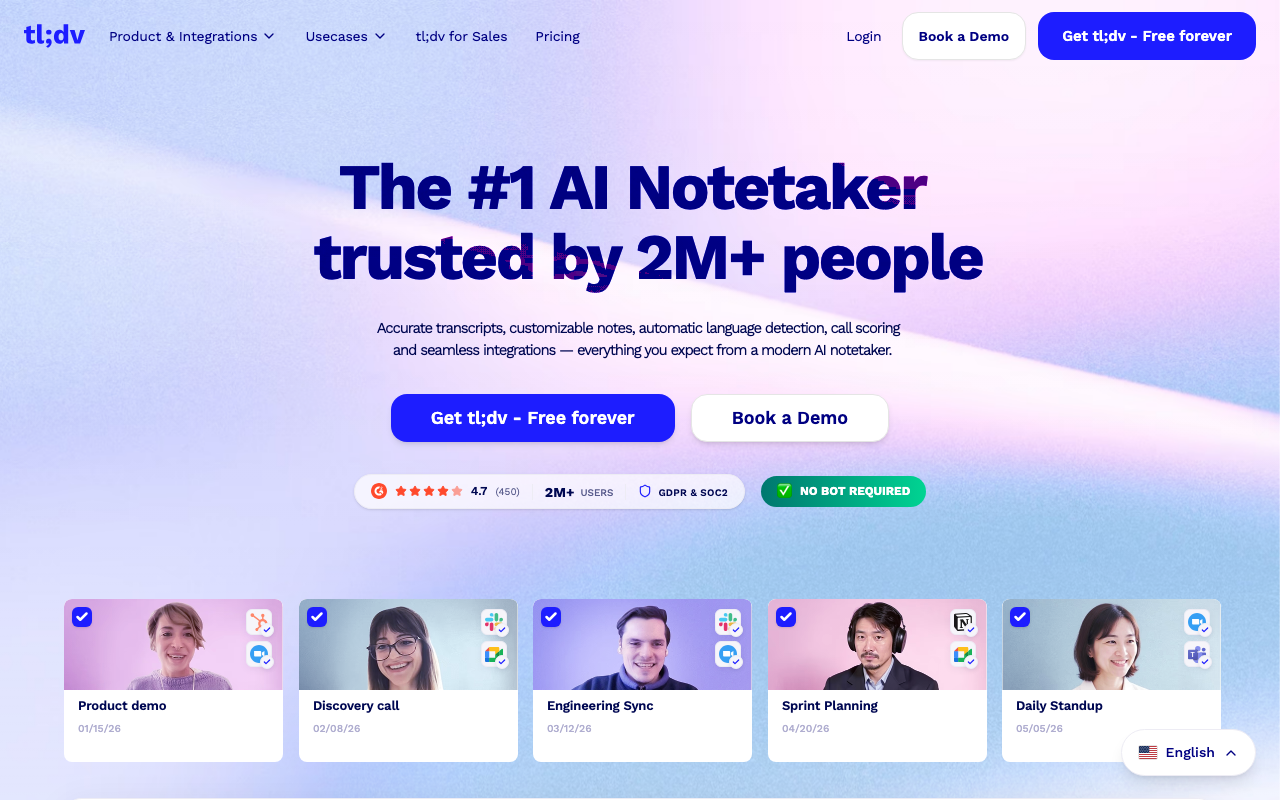
At its core, tl;dv is an AI notetaker that joins your calls, records and transcribes them in 40-plus languages, and produces a structured summary with action items and timestamped highlights. You can clip moments, share reels, and search across past calls by keyword or speaker. Over the past year it shipped botless recording so the assistant does not have to appear as a separate participant, which removes some of the awkwardness of a visible bot on prospect calls.
The strongest part of the product for sales teams is what happens after the call. tl;dv writes summaries, next steps, and custom fields back into the CRM, and the native integrations now cover HubSpot, Salesforce, Pipedrive, Close, and Attio with two-way sync. That means a call can pull contact and company context into the notes and push the outcome back to the deal automatically. For a small team that lives in its CRM, that loop saves real admin time.
AI agents and multi-meeting intelligence
tl;dv has leaned hard into AI features that go beyond a single transcript. Multi-Meeting Intelligence aggregates across hundreds of calls and surfaces patterns: which objections come up most, what stalls deals, how sentiment shifts over a quarter. There is also AI sales coaching that scores how closely a rep followed a chosen playbook, including MEDDIC and BANT frameworks, and generates targeted tips.
The newer AI agents are the most ambitious addition. They can draft follow-up emails, update deals in HubSpot or Salesforce, create tasks in Asana or Trello, and post summaries to Slack, all triggered from the meeting. This is closer to an autonomous post-call workflow than most recorders offer at this price. Treat the agent output as a draft to review rather than a hands-off automation, especially when it writes to your CRM, but the direction is genuinely useful for a lean team.
Where tl;dv lands on AI-stack fit
CR Buddy scores tl;dv at 84 on AI-stack fit, which puts it near the top of the conversation-intelligence category. The reasoning is straightforward. tl;dv exposes a documented REST API with x-api-key auth covering meetings, transcripts, highlights, and notes, plus webhooks on the Business plan, and a very wide integration surface with native connectors plus Zapier and n8n bridging it to thousands of other tools. If you want transcripts, summaries, and call metadata flowing into your own systems or a data warehouse, the plumbing is there and well documented.
tl;dv now ships its own official MCP server, the tldv-mcp-server, so an assistant like Claude or a Codex-style agent can pull meeting context directly through a native protocol rather than only through the REST and webhook layer. Running it requires a Business or Enterprise account plus an API key, which keeps the native agent path behind a paid tier, but the capability is real and vendor-maintained. That combination of an official MCP server and a solid documented API is exactly why the score sits at 84, putting tl;dv level with Avoma at the top of this category.
Pricing notes
tl;dv keeps a free plan that is more generous than most rivals: unlimited recordings and unlimited transcription, with a hard cap on AI summaries per month. That cap is the conversion lever, and for a low-volume user the free tier is a real option, not a teaser.
Paid plans follow the usual pattern. The headline Pro rate is billed annually and runs noticeably higher month to month, and it unlocks unlimited AI summaries plus the integration features most sales teams actually buy tl;dv for. The Business tier steps up to advanced CRM field mapping, team analytics, and AI coaching, and the jump from Pro to Business is steep, roughly several times the per-seat cost. Prices and limits shift often in this category, so verify the current numbers and what each tier unlocks on tl;dv's pricing page before you commit, and confirm the billing period since the annual discount is large.
The verdict
tl;dv is one of the best-value AI meeting recorders for sales teams that want capable transcription, strong CRM write-back, and a free plan that does not feel crippled. It will not replace a dedicated revenue-intelligence platform if coaching and forecasting depth are your priority, but for the price it delivers more than its tier suggests, and the AI agents push it past simple notetaking.
Weighing alternatives? Fathom is the closest free-first competitor and worth a side-by-side, while Fireflies.ai leans harder into search and knowledge across a large meeting archive. See the full best conversation-intelligence roundup for the head-to-head.