

Who Outreach is for
Outreach is for mid-market and enterprise sales orgs that run disciplined, multichannel cadences and want execution, conversation data, and forecasting under one roof. If you have a team of SDRs working structured outbound, AEs managing real pipeline, and a RevOps function that lives in reporting, Outreach is built for exactly that shape of organization. It assumes process, headcount, and a Salesforce or similar CRM underneath it.
It is the wrong tool if you are a small team or a solo seller who just wants to send sequences and book meetings. The platform is priced and scoped for scale, onboarding takes real time, and the breadth is overkill when you need three channels and a dashboard. A lean team will move faster and pay far less with something like Apollo, which bundles prospecting data with sequencing in a self-serve package. Outreach earns its keep when the coordination problem across a large team is the actual bottleneck.
What Outreach actually does
The core has always been sequencing: multi-step, multichannel cadences across email, phone, and LinkedIn, with logic that routes reps to the next best action and surfaces who to call when. That engine, paired with one of the strongest reporting layers in the category, is why large sales orgs standardized on Outreach in the first place. Sales leaders consistently rate the analytics among the best reasons to buy it.
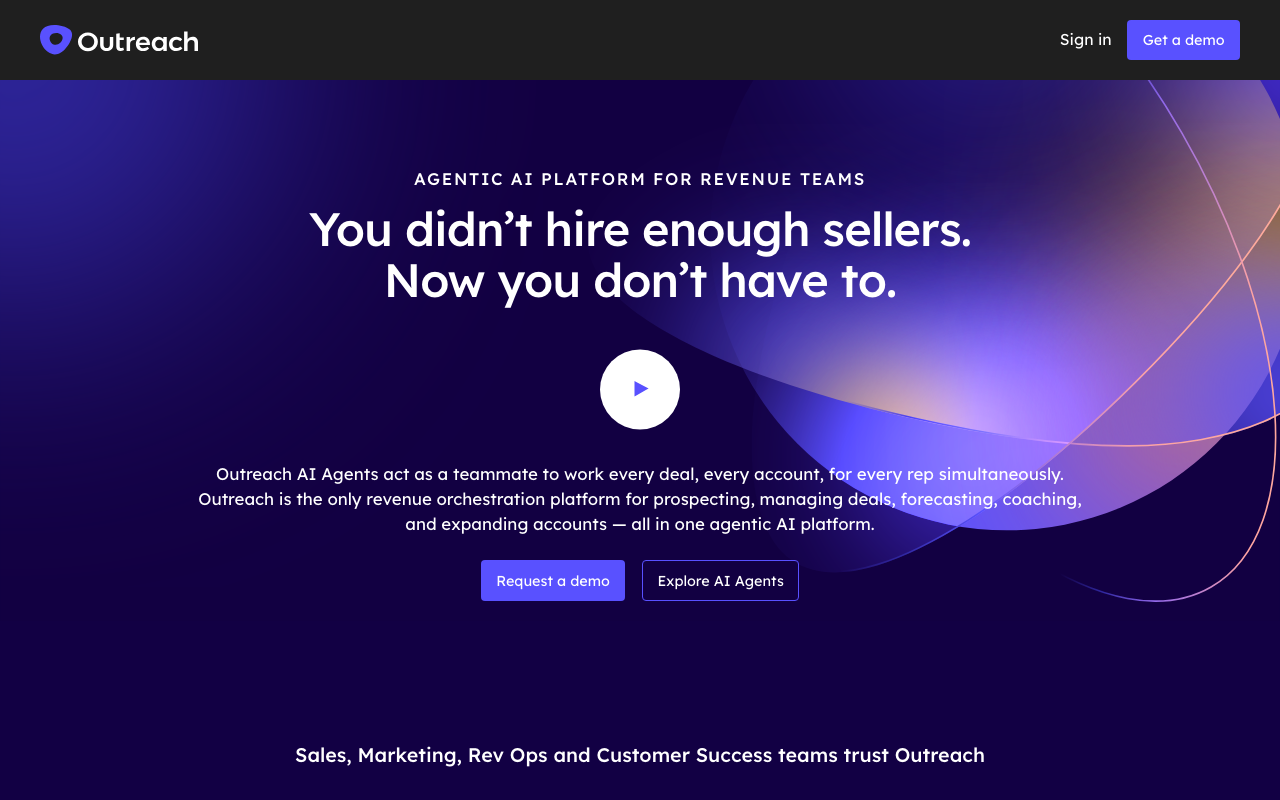
Over the past few years the product expanded well past engagement into a full revenue platform. You now get conversation intelligence (call recording, real-time battle cards, and objection handling), deal management that flags where pipeline is stalling, and AI-assisted forecasting that projects revenue from activity and buyer sentiment. Rep coaching tools sit on top, designed to scale the behaviors of your best performers across the team. The pitch is one system for the whole revenue motion rather than a sequencing tool bolted to a separate forecasting product.
The agentic AI rebuild
Outreach has reoriented the entire platform around AI agents, to the point that its product now lives at outreach.ai. The Amplify layer introduces AI agents meant to autonomously execute work across the customer lifecycle: drafting and personalizing outreach, recommending actions on deals, and handling research and follow-up steps that used to sit on a rep's plate. This is a genuine product direction, not a feature sticker, and it is the main thing that has changed since the older "sales engagement" framing.
Treat the autonomy claims with healthy skepticism until you see them on your own data. Agentic features across this whole category are early, and Outreach's value for most buyers still rests on the proven sequencing and analytics core. The AI work is a reason to watch the roadmap closely, not the reason to sign by itself.
Where Outreach lands on AI-stack fit
CR Buddy scores Outreach 86 on AI-stack fit, which puts it near the top of the category. Outreach has a mature REST API built on the JSON API 1.0 spec, with OAuth 2.0 auth and a published OpenAPI schema, so your own code or an outside agent can push records in, pull activity and call data out, and trigger sequence actions. Combined with the native AI agents, that makes it a capable, AI-forward platform for teams that build their own integrations.
It now also ships a first-party MCP server, which is generally available. An assistant like Claude can drive Outreach directly once the server is installed, and the same server supports ChatGPT, Codex, Copilot, and Gemini. The catch is access: the MCP server requires an active seat, the Amplify add-on, and admin enablement, so it is not on by default for every plan. If you would rather not use MCP, any agent you build can still talk to Outreach through the REST API, or through middleware like Zapier or Make. It also slots cleanly alongside Salesforce and ChatGPT via the API, so if your stack is API-first you can wire it in without much friction.
Pricing notes
Outreach does not publish prices, and that is the most common complaint in every review. Expect a custom, quote-based contract billed annually, with no self-serve monthly option. The newer model combines seat-based pricing with consumption-based AI credits, sold in Amplify Core, Plus, and Pro tiers (roughly 25,000, 50,000, and 100,000 credits) where discrete actions burn predefined credit amounts and you can buy more on top. Professional services packages for onboarding are sold separately.
Independent reviews put real-world cost well into the low-to-mid three figures per user per month at scale, but those numbers move with team size, the modules you turn on, and how heavily you use the AI features. Do not anchor on any single figure. Verify the current structure and your actual quote on the vendor's pricing page and through sales, and pin down credit costs before you commit, because consumption pricing makes two similar teams pay very different bills.
The verdict
Outreach is a category leader for sales execution at scale, and it is priced accordingly. If you run a large, process-driven revenue team and want sequencing, conversation intelligence, and forecasting in one platform with a credible AI agent roadmap, it belongs on your shortlist. If you are a small team, the cost and onboarding will outweigh the benefit, and you should look lighter.
The closest decision is against Salesloft, its main rival with a near-identical platform scope, so pick on ecosystem fit and the quote you actually get. For lean teams, Apollo covers the prospecting-plus-sequencing job for a fraction of the price. See the full best sales-engagement roundup for the head-to-head.