

Who Default is for
Default is for the RevOps person who is tired of stitching together a separate form tool, a routing tool, a scheduler, and an enrichment vendor and praying the handoffs do not drop leads. If your inbound volume is high enough that speed-to-lead matters, and you want one workflow builder that catches a form submission, enriches it, assigns it to the right rep by territory or account ownership, and books the meeting on the spot, Default is built precisely for that job. Mid-market and enterprise teams running Salesforce or HubSpot are the core buyers.
It is a weaker fit if inbound is not your main motion. Default deliberately solves the inbound half of GTM and leaves outbound alone. There is no prospecting database, no cold-email sequencer, and no buying-signal monitoring in the way a tool like Pocus approaches product and warehouse signals. A team whose pipeline comes from outbound or PLG signals should look elsewhere first, or pair Default with a separate prospecting stack.
What Default actually does
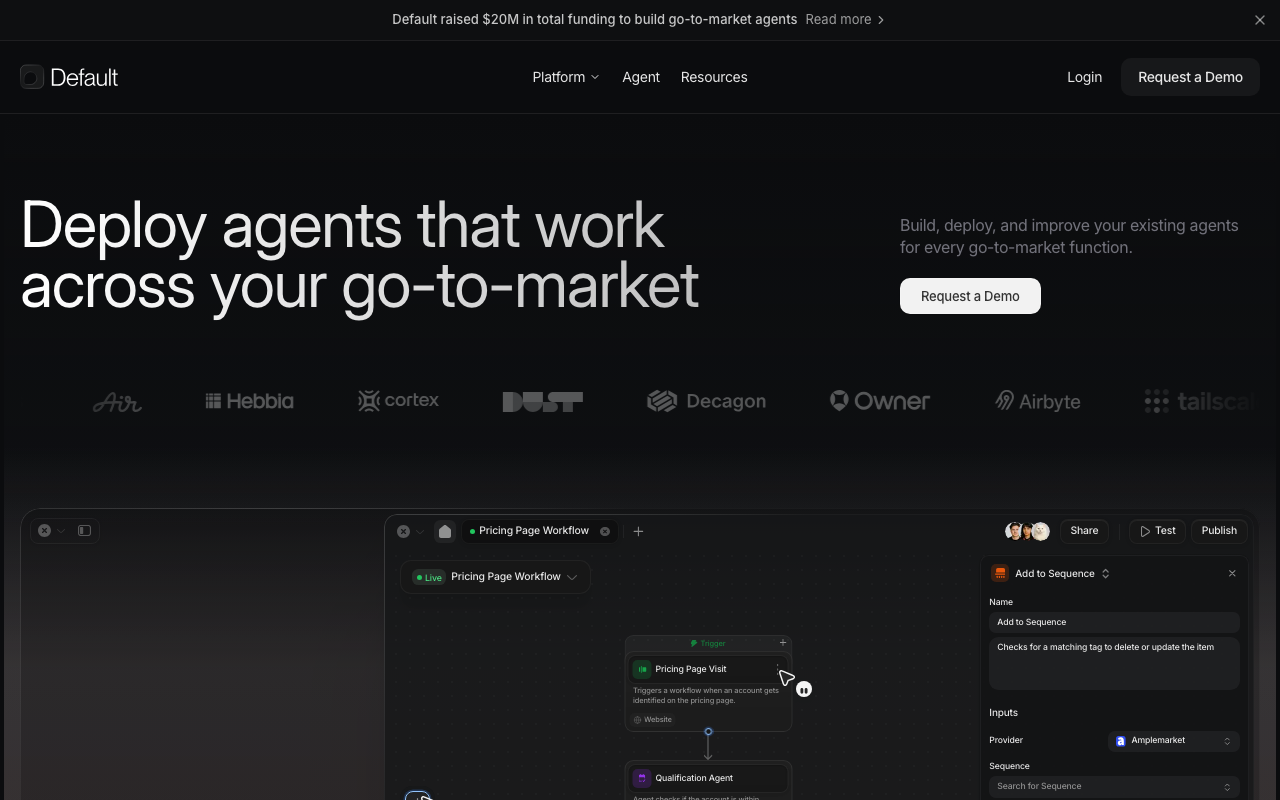
The core of Default is a visual workflow builder that runs the path from form to meeting in real time. A lead submits a form, Default enriches it with firmographic data through connected providers like Clearbit and Apollo, then applies your rules (company size, industry, geography, existing account ownership) to assign the lead and present a calendar for instant booking. Most teams report going live within about a week, which is fast for this category and a real contrast to the multi-month rollouts that LeanData and Chili Piper are known for.
Beyond the headline routing flow, Default keeps CRM data tidy with scheduled enrichment workflows and automated de-duping, and it can alert reps when target accounts are active on your site. The routing logic lives in a single builder rather than scattered across triggers, which is the practical reason RevOps teams pick it: one place to see and change how leads move.
Default is repositioning around agents
The newer story on Default's own site is broader than inbound routing. Default now describes itself as AI infrastructure for revenue teams, built on a unified, identity-resolved data layer that pulls together CRM, website, forms, enrichment vendors, ad platforms, and conversation tools. On top of that sit Workflows and Tables (shared data views meant for both humans and agents) and Dot, a natural-language agent that turns plain-language requests into working systems. Audit logs, approval gates, and version history with rollback are the guardrails that make agent-driven changes safe to ship. This is an ambitious direction, and it is worth watching, but the proven, mature part of the product today is still the inbound engine.
Where Default lands on AI-stack fit
Default earns an 85 AI-stack-fit score from Chief Revenue Buddy, which puts it near the top of the revops field. The data layer and the Dot agent are genuinely AI-native concepts, and the company is openly building toward GTM agents, having raised funding specifically for that. So the philosophy points the right way.
Default backs that philosophy with native MCP support. Its site documents MCP access to the data layer and every tool for any agent, whether that agent is built inside Default or runs on top of it, which means an assistant like Claude Code or Codex can drive Default's data and tools directly. Default also exposes a REST-style API and bi-directional integrations with the usual revenue tools (Salesforce, HubSpot, Attio, Apollo, Snowflake, Calendly), so your own code can push and pull records too. Dot remains Default's own in-product agent, but the MCP layer means your outside agents are first-class as well. One note for buyers: Default describes MCP in its product copy rather than publishing a standalone server spec or developer reference, so confirm the exact endpoints with the vendor before you wire up a critical workflow.
Pricing notes
Default uses a platform-plus-seat model, which is more transparent than the volume-based pricing common in this category. The lowest published platform fee is $500 per month on the Growth plan, with seats split by role: $20 per scheduling seat and $45 per routing seat, while admin and editor seats are typically free. There is also a Startup plan at $750 per month billed annually. Default has no free plan and no free trial. One caveat on sourcing: Default's own /pricing URLs currently return 404, so these figures come from recent third-party reviews and should be re-verified once the vendor pricing page is reachable. That base fee makes Default hard to justify for an early-stage team with low inbound volume.
The verdict
Default is a tidy, AI-native replacement for a patchwork of inbound tools, and for inbound-heavy mid-market teams it is a clean, fast-to-deploy choice that consolidates four jobs into one builder. Go in clear-eyed that it covers the inbound half of GTM, not the whole motion, and that its agent story is promising but still maturing. If your needs run toward forecasting and broader revenue operations, look at Clari, and if intent and signal-based selling is the priority, Pocus is the closer match. See the full best revops roundup for the head-to-head.