

Who Pocus is for
Pocus is for product-led and signal-rich GTM teams that already sit on a pile of usage data and do not know what to do with it. If your product has a free tier or a self-serve motion, and your reps spend half their week guessing which of 10,000 signups are actually worth a call, Pocus is built for exactly that problem. Its named customers skew toward PLG-heavy SaaS like Asana, Monday, Webflow, and Canva, which tells you who gets the most value: mid-market and enterprise teams with clean CRM data and a real product-usage feed to mine.
It is a worse fit if your buying signals live outside the product. Pocus is strongest at scoring accounts on product usage and intent, so a pure outbound team selling into companies that never touch a free trial will find thinner signal to work with. If you want classic forecasting, deal inspection, and pipeline analytics across a traditional sales motion, a revenue platform like Clari is the more natural home. Pocus pays off when product behavior is the thing that predicts a deal.
Signal-based selling, turned into a daily action feed
The core idea behind Pocus is signal-based selling. It pulls internal data (CRM records, product usage, call recordings, emails) and combines it with external intent signals, then scores and ranks accounts so reps act on the warmest ones first. Pocus monitors those accounts around the clock, so the prioritization shifts as behavior changes rather than going stale the day after an export.
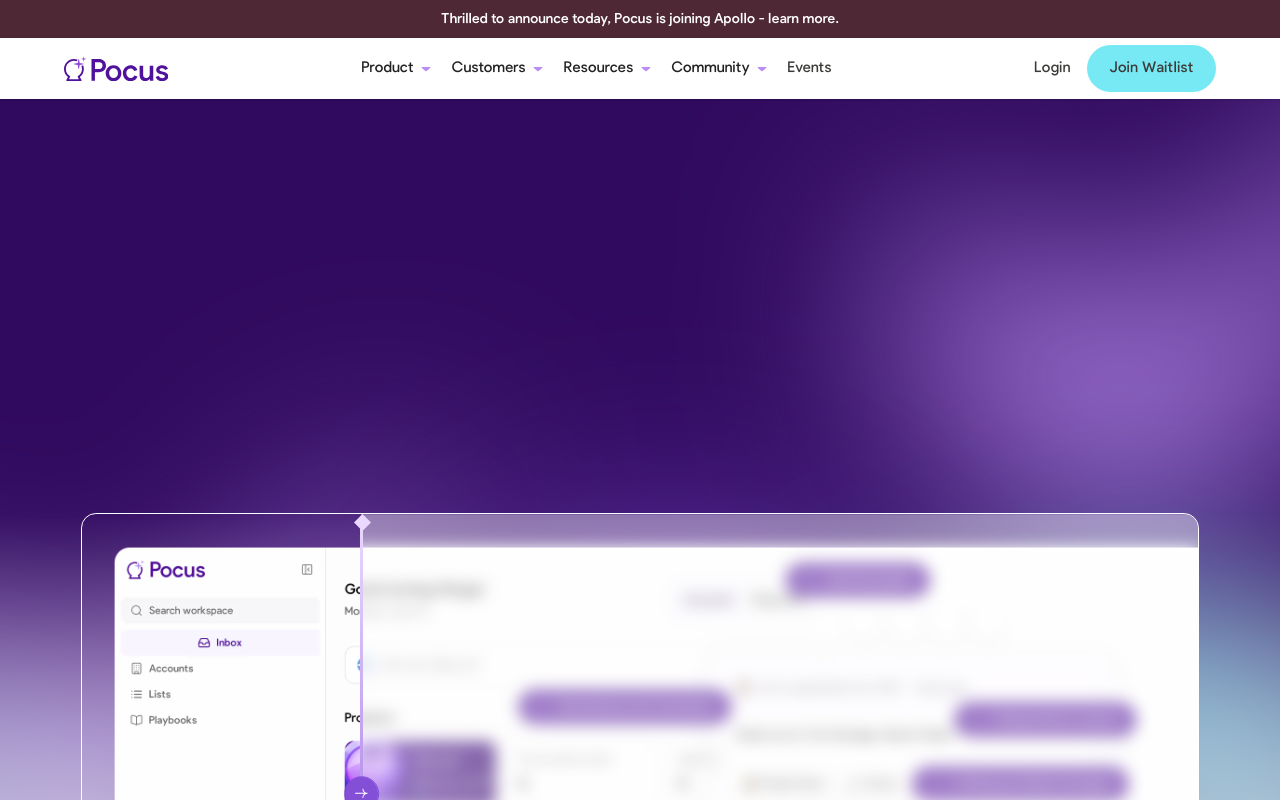
The piece that makes this usable day to day is the Intelligent Inbox. Instead of handing a rep a dashboard to interpret, Pocus delivers a prioritized list of who to work and why, framed as a daily set of actions, which is the difference between a scoring model and a tool reps actually open. Pocus pairs the scoring with playbooks and triggers, so a signal can fire a defined motion (a research step, a suggested contact, a messaging angle) rather than just lighting up a number. Pocus's own claim is roughly 30% more pipeline and 10-plus hours saved per rep per week, a vendor number worth pressure-testing in a pilot rather than taking at face value.
More recently Pocus has leaned into AI agents that prioritize accounts, research prospects, suggest contacts, and draft outreach, plus a Chrome extension for LinkedIn research. The honest limit: it is anchored in product and intent signals, so event triggers like a new CEO, a funding round, or a strategic shift on an earnings call are not its strength. For those, you would add a dedicated intent or research layer alongside it.
Where Pocus lands on AI-stack fit
Pocus earns a 48 on CR Buddy's AI-stack-fit scale, which puts it in the lower tier for a revops tool. The reasoning is consistent across the board: Pocus connects to a data stack through prebuilt connectors, but it offers no documented public API and no MCP server, so it is not agent-drivable from the outside.
On the connector side, Pocus pulls signals through warehouse and CRM integrations, and it works with Salesforce, Snowflake, HubSpot, and automation layers like Zapier or Make. That means you can feed it product events and intent data and pipe its scores back into the tools reps already live in. What it does not give you is a public, self-serve API: there is no developer portal or documented REST reference, so any programmatic read or write access has to be arranged as a custom enterprise deal rather than built against published docs.
The other gap is MCP. Pocus does not ship a first-party MCP server, and no community server exists, so an assistant like Claude Code or ChatGPT cannot drive it directly the way it can an MCP-native tool. Pocus's own AI agents run inside the product, not as something your external stack can orchestrate. The combination of no public API and no MCP is why it lands low on this scale despite the clean connector list.
Pricing notes
Pocus does not publish pricing. It is a custom, annual-contract platform with no free plan and no public tiers, so the only way to get a real number is a sales conversation. Third-party trackers put mid-market deals somewhere in the mid five figures per year, but treat that as a rough estimate, not a quote.
There is a bigger caveat than the opacity. Apollo.io acquired Pocus in March 2026, and Pocus is being folded into Apollo's GTM platform rather than sold as a fully standalone product. If you are evaluating Pocus today, you should expect to talk to Apollo about how the signal-scoring capability is packaged inside its platform, and what that means for contracts, roadmap, and migration. Verify the current structure and any numbers directly with the vendor before you sign anything, because the post-acquisition packaging is still settling.
The verdict
Pocus built one of the better signal-based selling engines for product-led teams: strong scoring, a daily action feed reps will actually use, and clean data-pipeline integrations. The 48 AI-stack-fit score reflects a tool that connects to a modern data stack through prebuilt integrations but offers no public API and no MCP server, so an external agent cannot drive it. The wrinkle is the Apollo acquisition, which makes the standalone story uncertain, so weigh that against the upside of buying the capability inside a broader platform.
If product usage predicts your deals, Pocus is worth the demo. If you need forecasting and deal inspection across a traditional motion, look at Clari, and if you are modernizing inbound capture and routing, Default is the tidier fit. Compare the field in the full best revops roundup.


