

Who Ocean.io is for
Ocean.io is for ABM and demand-generation teams who already know their best customers and want more accounts that look exactly like them. If you can point at ten closed-won logos and say "find me 500 more companies with this shape," that is the job Ocean.io does well. Marketers building target-account lists, RevOps people tightening an ICP, and founders running account-based outbound get the most out of it.
It is a weaker fit if you want a general-purpose contact database or an all-in-one prospecting platform. Ocean.io is a targeting tool first and a data vendor second, so a solo AE who just needs verified emails and a sequence will be better served by a broader, cheaper platform like Apollo. Ocean.io earns its keep when the hard part is deciding which accounts to chase, not chasing them.
Lookalike account discovery is the core
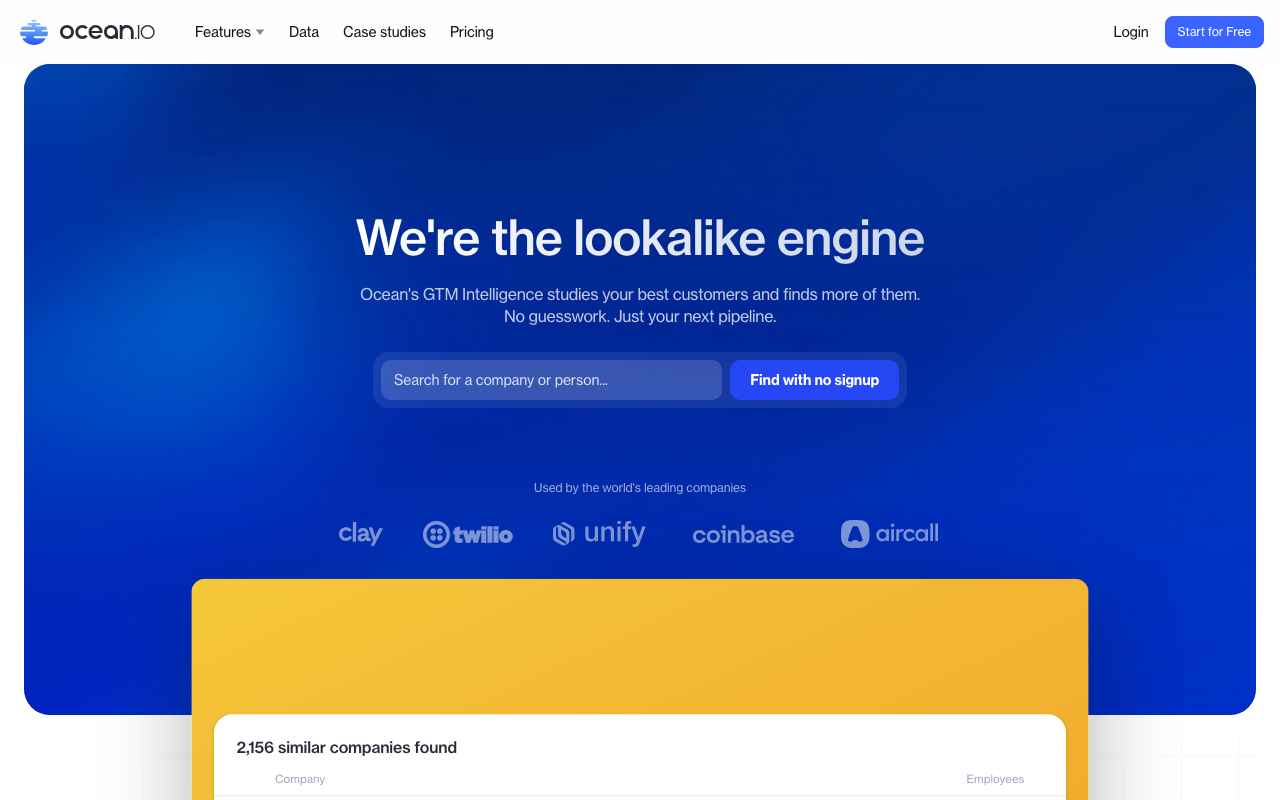
The center of Ocean.io is lookalike search. You feed it a domain, a company name, or a set of your best or most recently closed customers, and its AI returns companies that resemble them across firmographic and technographic patterns. Instead of hand-building filters for industry, size, and tech stack, you let the model infer the shape of a good account from real examples. Teams use this to expand a thin target list or to sanity-check an ICP they thought they understood.
On top of lookalike search, Ocean.io provides contact data, emails and phone numbers, for the people inside those accounts, plus CRM enrichment that auto-populates company details from a single domain or business email. The pitch is a tight loop: find the right accounts, surface the right contacts, push them where your team already works. Users on G2 and Capterra consistently call it easy to navigate and praise the quality of the fit-based targeting, which is the part Ocean.io is genuinely good at.
Where Ocean.io lands on AI-stack fit
Ocean.io scores 74 on CR Buddy's AI-stack-fit scale, a solid result that reflects a real API plus an early community MCP wrapper. The good news first: Ocean.io ships a REST API, and API access is included across plans, so your own code or an enrichment pipeline can call it directly. Native CRM integrations cover HubSpot and Pipedrive well, with Salesforce support maturing, and you can wire it into the rest of your stack through Zapier or Make. Pushing a freshly built lookalike list into a CRM and triggering downstream workflows is a supported path, not a hack.
Ocean.io does not publish its own MCP server, but a third-party community server (Meerkats-Ai/ocean-io-mcp-server) wraps the Ocean.io API so an assistant like Claude or a Codex-driven agent can call lookalike search and enrichment over MCP. That server is early-stage, with minimal adoption, so treat it as experimental rather than production-grade. For most teams the dependable path is still the REST API and integration layer, which means some glue to write and maintain. The 74 reflects exactly that: a real API, native CRM hooks, and a community MCP option that is promising but not yet battle-tested.
Pricing notes
Ocean.io's pricing is the most common complaint and the biggest reason to slow down before signing. CR Buddy lists the entry point as 79 dollars per month for the Premium plan, billed monthly, with a Professional plan at 129 dollars per month above it and a custom enterprise tier for higher volume. A 14-day free trial lets you test it before paying. Higher-volume teams still tend to land in a custom quote, so the published tiers are the floor, not the ceiling.
Treat these numbers as directional. Pricing pages change and public tiers do not always match what sales quotes, so verify the current structure and your specific number on the vendor's pricing page before you budget. The honest caveat from reviewers is value at the price: a few users feel the database is not worth the spend compared with broader vendors. Run the trial against your own ICP and confirm match quality on accounts you actually want before committing to an annual deal.
The verdict
Ocean.io is a focused tool that does one thing well: it finds more accounts that look like your winners. If account-based targeting is the bottleneck and you have budget for an annual contract, it is a credible pick, and the CRM enrichment is a useful bonus. Go in clear-eyed about the two real limits, a price that runs higher than broad data vendors at the same tier and a scope narrower than full-stack data vendors, and validate fit quality during the trial.
If you want a build-it-yourself prospecting engine with waterfall enrichment and AI research, Clay is the stronger AI-native choice, and Apollo is the better all-in-one if you need data and sequencing in one turnkey platform. See the full best prospecting roundup for the head-to-head.