
State of MCP in sales software: 2026
Chief Revenue Buddy scored 83 sales tools for MCP support, API depth, and agent-readiness. Here is what the data says about your AI stack.
Chief Revenue Buddy · 5 min read · Updated 2026-07-10
The headline number
Chief Revenue Buddy scored 83 sales tools for how well they fit an AI-driven stack. Of those, 41 (about half) ship an official Model Context Protocol (MCP) server, another 11 rely on a community-built one, and 31 (about a third) offer no MCP path at all. The average AI-stack-fit score across the catalog is 74 out of 100.
The most quotable finding is an irony. The category that markets itself hardest on artificial intelligence, AI SDRs and autonomous agents, is the least agent-ready software in sales. Only 1 of the 13 AI SDR tools in the catalog exposes an official MCP server. The category average is 58, the lowest of any group and 16 points below the catalog mean.
If your plan is to run sales from Claude, Codex, ChatGPT, or Gemini, the data is clear: the tools built to be AI are often the worst at connecting to yours.
How the score works
Every tool in the AI-stack-fit leaderboard gets a 0-100 score built from three inputs:
- MCP support. Does the vendor ship an official MCP server (full credit), is there a credible community server (partial), or neither?
- API depth. Is there a public REST or GraphQL API that covers the real objects (records, pipeline, messages), or is access locked behind partner programs?
- Agent-readiness. Auth model, write access, rate limits, and how cleanly an agent can read and change state without a human in the loop.
Scope: 83 tools across 8 categories (CRM, prospecting, cold outreach, sales engagement, meeting and call recording, AI SDR, RevOps, and sales enablement), verified through July 2026. This is a curated catalog of tools a modern GTM team would actually shortlist, not a random sample of the whole market, so treat the adoption rates as "among serious contenders" rather than industry-wide.
MCP adoption across sales software
| MCP support | Tools | Share |
|---|---|---|
| Official server | 41 | 49% |
| Community server | 11 | 13% |
| None | 31 | 37% |
API access is more common than MCP: 74 of 83 tools (89 percent) expose a public REST or GraphQL API. The gap between "has an API" and "ships MCP" is the real story of 2026. Most vendors have the raw surface an agent needs; far fewer have done the work to make it agent-native.
The AI-readiness leaderboard by category
Ranked by average AI-stack-fit score, with the count of tools shipping an official MCP server.
| Category | Tools | Official MCP | Avg score | Most AI-ready |
|---|---|---|---|---|
| Meeting & call recording | 10 | 9 | 83 | Fireflies.ai |
| CRM | 10 | 6 | 82 | Attio |
| Cold outreach | 10 | 7 | 80 | Instantly |
| Prospecting & data | 16 | 9 | 76 | Clay |
| Sales enablement | 10 | 3 | 71 | Showpad |
| Sales engagement | 6 | 3 | 71 | Outreach |
| RevOps & forecasting | 8 | 3 | 70 | Clari |
| AI SDR & agents | 13 | 1 | 58 | Relevance AI |
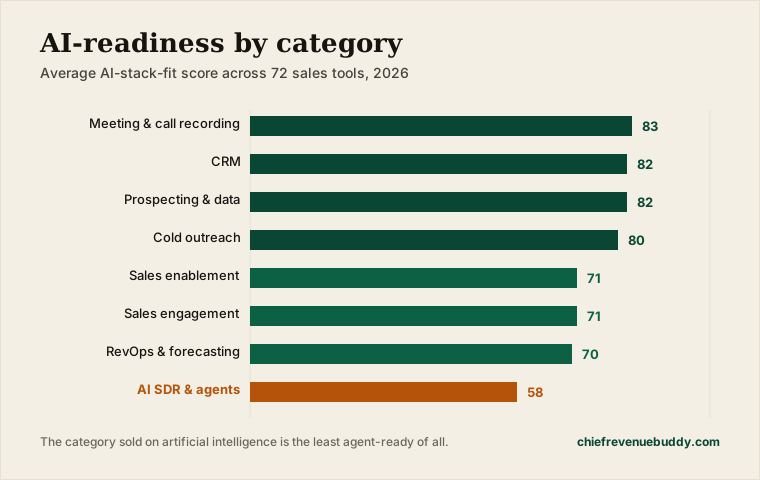
Meeting and call recording leads because the value is the transcript, and getting that transcript into an agent is the whole point. CRM follows close behind, which matters because it's the read-write core most agents need to touch. Prospecting sits lower than it used to as the catalog has grown, pulled down by a wave of narrowly-scoped email finders that ship a REST API but no MCP server.
The most AI-ready tools
The top of the catalog is a tight band. These tools pair an official MCP server with a real public API.
- Attio: 88 (official MCP, REST)
- Close: 88 (official MCP, REST)
- Clay: 87 (official MCP, REST)
- Salesforce Sales Cloud: 86 (official MCP, REST + GraphQL)
- Fireflies.ai: 86 (official MCP, GraphQL)
- Instantly, lemlist, Zoho CRM, Crustdata, Saleshandy, Amplemarket, Outreach, and Gong: all 86
The pattern: the leaders treat the API as a product, not a checkbox. Attio and Close were built API-first, Clay is automation-native, and Salesforce simply has the surface area to cover anything.
The laggards
At the bottom, the AI SDR category dominates. The six lowest-scoring tools in the catalog:
- Aomni: 42 (no MCP, no public API)
- Regie.ai: 42 (no MCP, no public API)
- AiSDR: 44 (no MCP, no public API)
- Groove (Clari): 44 (no MCP, no public API)
- Expertise AI: 44 (no MCP, no public API outside a custom Enterprise tier)
- Skrapp.io: 46 (no MCP, REST API)
Four of these six sell themselves as AI products. The reason they score low is structural: a closed AI SDR wants to be your agent, so it has little incentive to let your agent drive it. That is fine if you want a black box that books meetings. It is a problem if you are building a stack you control, because a tool with no MCP and a closed or nonexistent API cannot be a component in someone else's workflow.
What this means for your stack
If you are choosing software in 2026 with the assumption that agents will run more of your pipeline every quarter, three takeaways:
- Buy the connective tissue first. Your CRM and prospecting layer get touched by every agent. Pick ones that score high here. Attio and Clay are the clearest examples of tools that grow with an AI stack instead of fighting it.
- Be skeptical of "AI" labels. A product marketed as an AI SDR is not the same as a product your AI can use. Check the MCP and API line, not the homepage.
- Treat MCP as a leading indicator. A vendor that has shipped an official MCP server has decided agents are a first-class customer. That decision tends to show up everywhere else in the product.
The full, sortable scoring lives on the AI-stack-fit leaderboard, and the methodology behind every number is documented there. For the bigger picture on building around these tools, see how to build an AI-native sales stack.
Numbers reflect the catalog as verified in July 2026 and are refreshed as vendors ship MCP support. The data is free to use with a link.
Ready to pick a tool?
Browse the bestKeep reading
Prompt Claude for GTM: 6 rules
How to prompt Claude for GTM work: give it the goal not the steps, let it delegate to subagents, save skills instead of re-explaining, and give it memory.
5 min readArticleConnect your CRM to Claude or ChatGPT
How to connect your CRM to Claude or ChatGPT over MCP. Step-by-step setup for Attio, HubSpot, Close, Salesforce, Zoho, and monday CRM.
7 min readArticleRun your GTM stack with Claude Code
Practical examples of driving your sales stack from Claude Code and other AI agents over MCP, with a clear split of what each side does best.
6 min read