

Who Attio is for
Attio is for startups and modern GTM teams who want a CRM their automations can drive, not just a place to log calls. If you think of your CRM as a data layer that the rest of your stack reads from and writes to, Attio is built around that idea from the ground up. Founders, RevOps people, and ops-minded sales leads who want to model their pipeline the way they actually sell get the most out of it.
It is a weaker fit if you need a mature, batteries-included platform on day one. Attio has no native dialer, no built-in email marketing, and a thinner library of turnkey integrations than the incumbents. If you want one vendor covering marketing, sales, and service with a huge app marketplace behind it, HubSpot Sales Hub is the safer choice. Attio rewards teams who will use its flexibility, not teams who want defaults handed to them.
A CRM built like a data platform
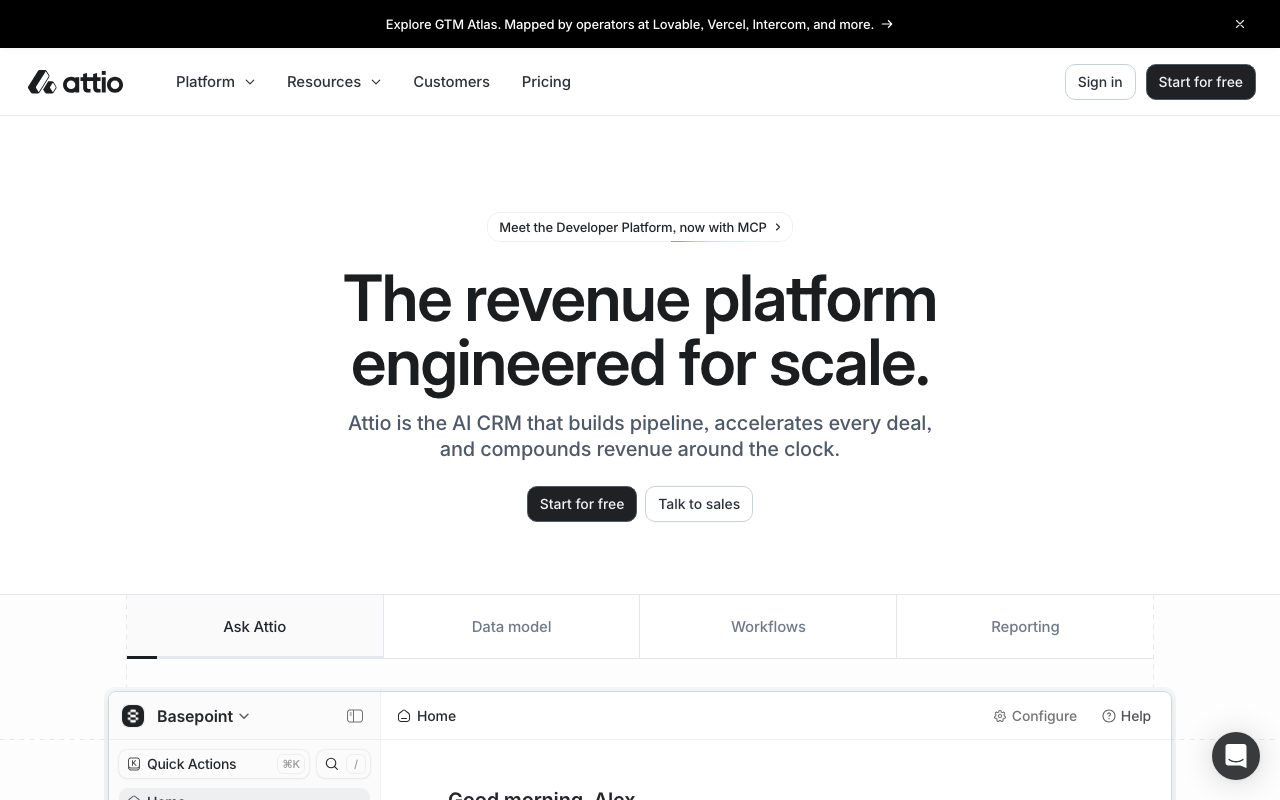
The core of Attio is a flexible, object-based data model. Instead of locking you into "contacts, companies, deals" and little else, Attio lets you create custom objects for whatever your business tracks: workspaces, partners, properties, investors, whatever maps to your motion. Every object has attributes you define, and records link to each other so you can model real relationships rather than flat lists. The interface feels closer to Notion or a fast spreadsheet than to a legacy CRM, which is a big part of why reps actually use it instead of fighting it.
Two things make it stronger than a pretty front end. First, enrichment: Attio auto-populates company and contact data and keeps records current, so your team spends less time on data hygiene. Second, the newer AI layer. Attio's AI attributes can summarize notes, generate consistent fields across records, and pull structured data out of messy inputs, and its AI workflows let you automate multi-step actions with model-driven triggers rather than rigid if-this-then-that trees. For a CRM this young, the automation story is further along than most.
Where Attio lands on AI-stack fit
This is where Attio earns its 88 AI-stack-fit score, near the top of the CRM category on Chief Revenue Buddy's leaderboard. Attio is genuinely API-first: every object and attribute is reachable programmatically through a clean REST API, which means your own code or an external agent can read and write the pipeline without scraping a UI. That alone puts it ahead of most CRMs.
The bigger development is MCP. Attio shipped a first-party hosted MCP server in early 2026, and it is a real one. It uses OAuth rather than API keys, auto-approves reads, asks for confirmation on writes, and stays inside each user's permissions with auditable logs. It covers people, companies, deals, custom objects, lists, notes, tasks, and even meeting and call data. In practice that means you can point Claude, ChatGPT, or another MCP client at your workspace and have it search, create, and update records in plain language. CR Buddy's score reflects the earlier community-server era, and the official server only strengthens the case: Attio is now one of the cleanest CRMs for an agent to drive directly. The catch worth knowing is that REST API access carries rate limits and some approval gating, so heavy programmatic workloads need planning.
Pricing notes
Attio runs a Free, Plus, Pro, and Enterprise structure, with the headline per-seat rates billed annually and higher month to month. The free plan is genuinely usable for early teams: up to three members, core CRM, email and calendar sync, and API access, which is rare to get for nothing. Plus is the entry paid tier for small teams and adds private lists and enhanced enrichment. Pro steps up to automations and more advanced reporting for scaling teams, and Enterprise adds SSO/SAML, audit logs, and dedicated support.
Two honest caveats. The published per-seat numbers have moved more than once, and different review sites quote different figures, so treat any specific price as a starting estimate and verify the current numbers on Attio's pricing page before you commit. And the jump from Plus to Pro is meaningful, so if automations and reporting matter to you, budget for Pro rather than assuming the entry tier covers it.
The verdict
Attio is the best CRM foundation if your stack is heading toward agents and automation. The object model is flexible, the interface is clean enough that adoption is not a fight, and the API plus the new first-party MCP server make it one of the easiest CRMs for an agent to operate end to end. Go in knowing the trade-off: the ecosystem is younger than Salesforce or HubSpot, native integrations are thinner, and reporting is improving but not yet enterprise-grade.
If that gives you pause, HubSpot Sales Hub is the more mature all-in-one, and folk is worth a look if you want a lightweight relationship CRM with less setup. For the full head-to-head, see the best crm roundup.