

Who folk is for
folk is for people who sell through relationships and have quietly hated every CRM they have tried. Founders running their own outreach, agency teams managing a book of warm contacts, and small sales teams who want pipelines without a four-week implementation are the sweet spot. If your selling motion is "stay close to a few hundred people and follow up at the right moment," folk fits the way you already work.
It is a weaker choice if you need deep reporting, forecasting, or heavy automation. folk keeps things deliberately light, so a RevOps lead who wants weighted pipeline math, territory rules, and dozens of custom workflows will outgrow it. If that is you, Attio gives you a similarly modern feel with far more depth on data modeling and reporting, and the older incumbents go further still. folk wins on speed and pleasantness, not on breadth.
A CRM that actually feels good to use
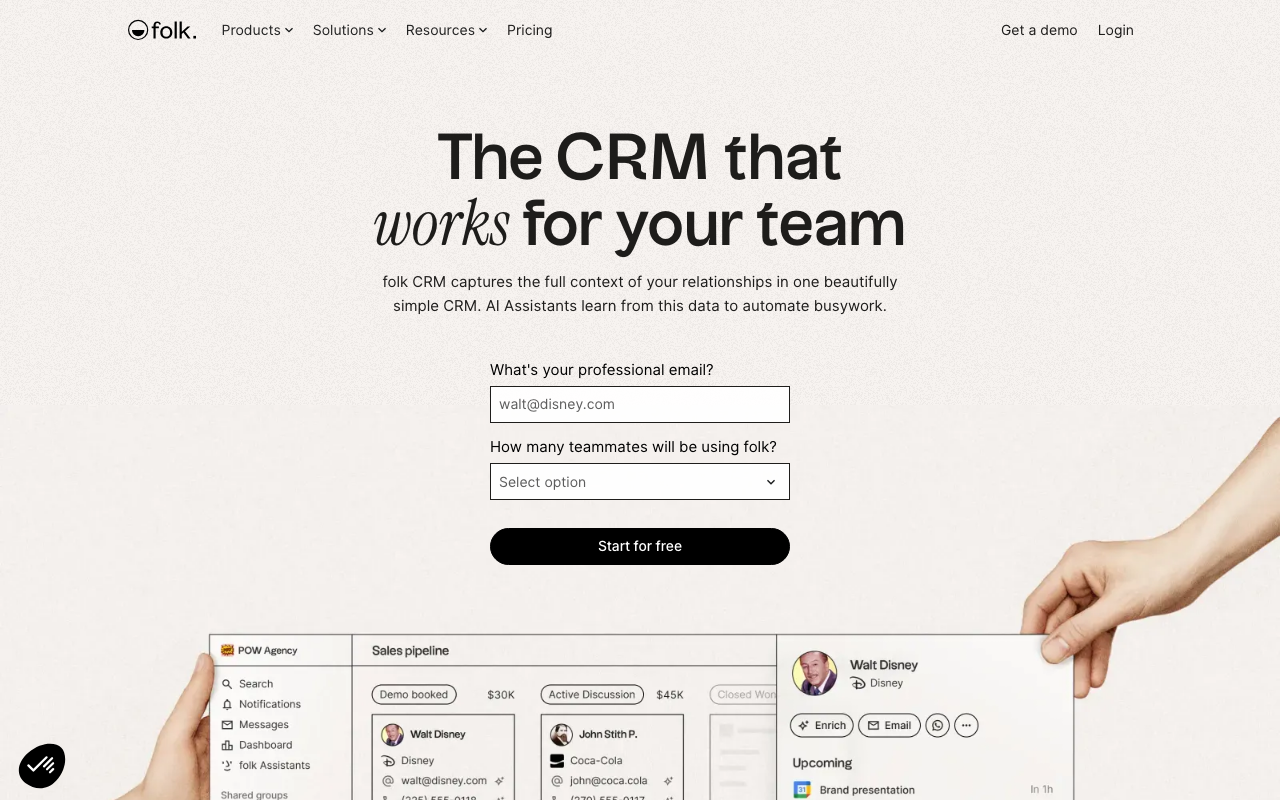
The core of folk is a clean, fast contact and pipeline view that you can set up in an afternoon. Reviewers who tested it in 2026 reported onboarding small teams in under an hour with no technical background, which matches the product's whole pitch. You import contacts, build a pipeline, and start moving deals without wrestling a settings maze.
Two things make folk more than a pretty address book. The first is the folkX Chrome extension, which pulls people and companies straight from LinkedIn into folk in a couple of clicks. For relationship sellers who live on LinkedIn, that capture flow removes most of the manual data entry that kills CRM adoption. The second is native multi-channel sync: email, calendar, and WhatsApp all connect, so the interaction history fills in around your contacts instead of forcing you to log every touch by hand.
AI assistance built into the contact, not bolted on
folk's AI is organized as a set of Assistants, including Follow-up, Recap, Research, and Workflow. The Research assistant enriches contacts and companies, the Recap and Follow-up assistants summarize threads and draft next messages, and AI fields let you generate structured data across your contacts. It is practical, in-context help rather than a separate chat window you have to remember to open. Standard plans include a monthly allowance of email finds and AI field generations, so enrichment is part of the product, not a bolt-on you buy separately.
Where folk lands on AI-stack fit
CR Buddy scores folk 76 on AI-stack fit, which puts it in solid mid-pack territory for a CRM. The product is genuinely AI-assisted inside the app, and outside agent access is reasonable for a CRM this lightweight. folk ships a documented REST API at developer.folk.app plus native and Zapier/Make integrations. There is no official MCP server, but a community MIT-licensed server (folk-crm-mcp) wraps that API so an assistant like Claude can reach folk over MCP. Agent control runs through the community MCP server, the REST API directly, or automation platforms.
There is one caveat worth flagging for the agent-minded buyer: API access sits on the Premium tier, not Standard. So if your plan is to have Claude Code or a custom script read and write folk records, budget for Premium from the start. With the API in hand, folk is scriptable enough for most relationship-CRM jobs, but it is a step behind tools like Twenty that expose every object through an API-first design. The integration breadth, with thousands of connectors through Zapier and Make, further closes the gap for no-code automation.
Pricing notes
folk uses per-seat pricing billed annually for the headline rate, with a higher month-to-month price if you pay monthly. There are three tiers: Standard, Premium, and a Custom plan. A two-week free trial with premium features runs automatically when you sign up, no card required.
Standard covers the core CRM: pipelines, email campaigns, contact enrichment, AI Assistants, the LinkedIn extension, and email, calendar, and WhatsApp sync. The important upgrades sit on Premium: custom objects and deals (the stage-based pipeline with proper deal records), email sequences, dashboards, advanced roles and permissions, and the API. So if you need real deal tracking, sequences, or programmatic access, you are on Premium, not Standard. Custom adds higher limits, dedicated support, and custom billing for larger teams. Enrichment runs on monthly credit allowances that increase by tier, so verify the current prices, credit limits, and which features sit on which tier on folk's pricing page before you commit, since plan contents change.
The verdict
folk delivers on its promise: it is the CRM for people who hate CRMs, modern and AI-assisted without the weight. If you sell through relationships and want a tool your team will actually keep open, it is one of the easiest CRMs to adopt in 2026. Go in knowing the limits. Reporting and heavy automation are thin, the ecosystem is younger than the incumbents, and first-party agent access depends on the Premium-tier API, with a community MCP server available on top of it.
Weighing alternatives? Attio is the better pick if you want the same modern feel with more data depth and reporting, and Salesflare is worth a look if your real problem is that nobody logs activity and you want the CRM to fill itself in. See the full best crm roundup for the head-to-head.