

Who Twenty is for
Twenty is for technical teams and GTM engineers who want a CRM they can own, script, and reshape rather than rent. If you think of your CRM as a data model that your code and your agents need to read and write cleanly, Twenty gives you full API access over every object, a Notion-style UI on top, and the option to self-host so your data never leaves your infrastructure. Founders escaping Salesforce or HubSpot lock-in, ops people who like building, and small teams that already live in their editor get the most out of it.
It is a worse fit if you want something turnkey on day one. Twenty is younger than the incumbents, so it has fewer prebuilt integrations and lacks enterprise features like CPQ, territory management, and multi-currency with automatic FX handling. Advanced reporting is thinner than Salesforce's native analytics too. A non-technical sales team that wants a polished CRM with a deep app marketplace and managed onboarding will be happier with Attio or HubSpot Sales Hub. Twenty pays off when ownership and programmability are the point.
An open-source CRM you build on, not just configure
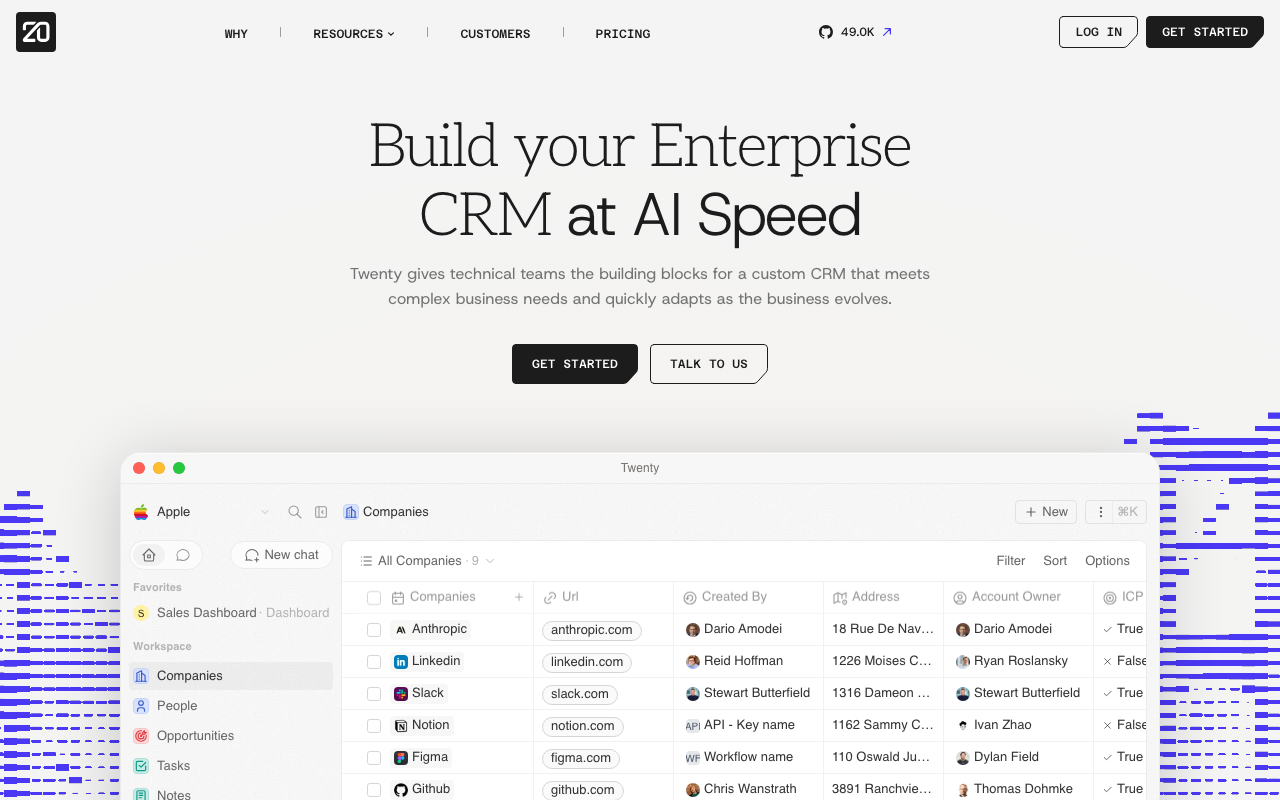
The core of Twenty is a flexible data model. You define custom objects, fields, and relationships, then view them as tables, Kanban boards, or filtered lists. That part feels familiar if you have used a modern CRM. What separates Twenty is that everything you see in the UI is also exposed through its API, so the same record an AE edits in the browser can be created or updated by a script, a webhook, or an agent.
The bigger story is the developer platform layered on the CRM core. Twenty ships a TypeScript apps framework, server-side logic, and no-code workflow automation, so you can extend the product rather than wait for the vendor to ship a feature. Custom apps and AI skills are treated as first-class, not afterthoughts. The project is AGPL-3.0 licensed and has become one of the most-starred CRM repos on GitHub, with an active Discord, which matters because the roadmap and your fixes move at community speed rather than enterprise-sales speed.
Self-hosting is the other defining trait. You can run Twenty on your own infrastructure for full data ownership, or take the managed cloud if you would rather skip the ops. For teams handling sensitive pipeline data or operating under strict compliance, owning the database the CRM runs on removes a class of vendor risk that most SaaS CRMs cannot.
Where Twenty lands on AI-stack fit
Twenty earns an 83 AI-stack-fit score from Chief Revenue Buddy, near the top of the CRM category, and the reason is structural. It is API-first by design, exposing both GraphQL and REST over every object, plus real-time webhooks. That means an agent or your own code can drive the entire CRM, not a curated slice of it. There is no hidden tier where the API suddenly disappears, which is a common trap with the incumbents.
On the agent-control side, Twenty's cloud workspaces now ship a native MCP server you can connect over OAuth, letting Claude, ChatGPT, or Cursor read and write CRM data in plain language. Community MCP servers also exist for self-hosted setups, so coverage depends on how you deploy. The combination of open source, full API depth, and self-hosting is what makes Twenty the cleanest agent foundation in this category: when your assistant needs to touch a CRM, fewer permission walls and no data-access friction beat a slicker UI. The caveat is that you are building on a younger platform, so expect to wire some of the connective tissue yourself.
Pricing notes
Twenty's pricing splits into two paths. Self-hosting is free under AGPL-3.0, with unlimited users and everything included, which is a genuine option if you have the engineering to run it. The managed cloud starts on a Pro plan in the region of $9 per user per month, with an Organization plan around $19 per user per month adding row-level permissions, SAML and OIDC SSO, custom domains, audit logs, and priority support. Both cloud tiers include unlimited API calls, webhooks, and REST and GraphQL access rather than gating them behind add-ons. Billing is monthly or yearly, and the yearly option carries a discount, with a 30-day trial and no card required to start.
Prices and plan contents shift as the product matures, so verify the current numbers, rate limits, and what each tier unlocks on Twenty's pricing page before you commit. The honest caveat is total cost of ownership on the self-hosted path: free software is not free to run, so factor in hosting, upgrades, and the engineering time to maintain it.
The verdict
Twenty is the most agent-friendly CRM foundation available right now, provided you are willing to build on it. If you value data ownership, full API access, and an open roadmap over a deep app marketplace and turnkey enterprise features, nothing in this category gives you a cleaner base. Go in expecting to invest engineering time, and treat the self-hosted route as a real project, not a weekend setup.
Weighing alternatives? Attio is the stronger pick if you want a modern, polished CRM without running infrastructure, and HubSpot Sales Hub wins on integrations and managed onboarding for non-technical teams. See the full best crm roundup for the head-to-head.