

Who Klenty is for
Klenty is for SMB and mid-market sales teams that want real multichannel sequencing without paying enterprise prices. If your SDRs run email, calls, LinkedIn, SMS, and WhatsApp steps from one place, and you want a per-seat price that does not require a procurement cycle to approve, Klenty fits the brief. Teams with a few reps up to a few dozen get the most out of it, especially when there is someone owning sales ops who can wire up the CRM sync and cadence logic.
It is a worse fit for two groups. If you are an enterprise with complex territory rules, deep analytics needs, and a budget that can absorb a platform fee, Salesloft and Outreach are more proven at that scale. And if you are a solo rep who just wants inbox tracking and light campaigns, Klenty is more platform than you need. Klenty sits in the middle: more capable than an inbox plugin, more affordable than the category leaders.
Multichannel cadences that actually cover the channels
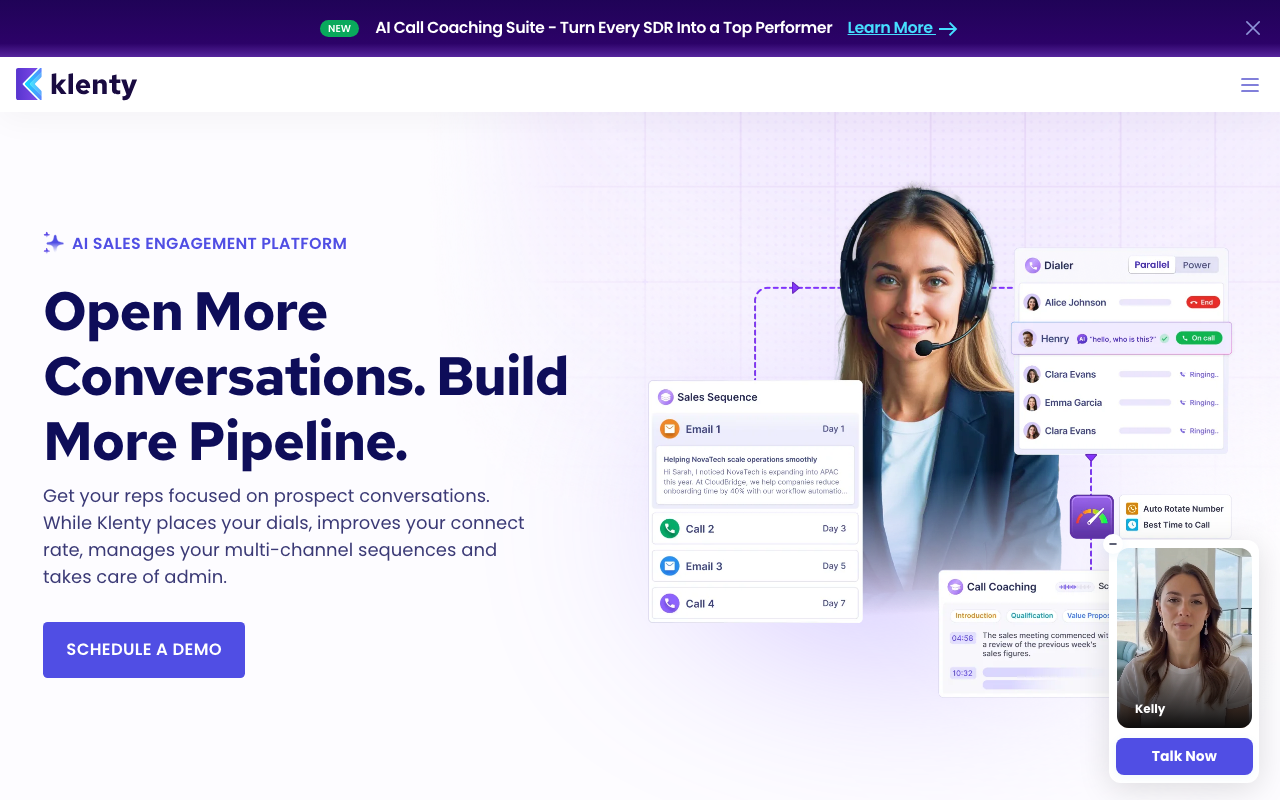
The core of Klenty is the cadence: a sequence of steps that mix automated emails with manual touches across calls, LinkedIn, SMS, and WhatsApp. Where some "multichannel" tools really mean email plus a reminder to do everything else by hand, Klenty builds the other channels into the workflow. Reps work a daily task queue, and the platform tells them who to call, who to message, and what to send next.
Two pieces carry most of the value. The first is the dialer. Klenty offers parallel and power dialing that can push call volume well up per hour, with voicemail detection and IVR detection so reps are not stuck listening to dead air. Note that the dialer is a paid add-on on top of your seat price, so the headline plan cost is not the whole calling story. The second is CRM sync. Klenty connects to Salesforce, HubSpot, and Pipedrive, and the integrations are deep enough that you can trigger cadences off CRM stage changes and write activity back automatically, which is the part teams care about most when they leave a thinner tool.
The Kai AI assistant
Kai is Klenty's AI layer, and it does more than draft copy. It writes personalized emails by reading a prospect's website and LinkedIn profile and pulling context into the message, which is table stakes now, but it also handles prioritization: scoring and surfacing the accounts a rep should work first. On the higher plan, Kai adds call coaching, live transcription, and AI objection detection, so the calling side gets the same treatment as the email side. This is closer to a working assistant than a bolt-on writing feature, and it is the main reason Klenty reads as more modern than its price suggests.
Where Klenty lands on AI-stack fit
Klenty scores 68 on Chief Revenue Buddy's AI-stack-fit scale, which puts it in the solid-but-not-leading band. The reason is straightforward: the integration story is good, the agent-control story is not finished.
On the plus side, Klenty ships a documented REST API at api.klenty.com with roughly twenty endpoints, so external code can create prospects, start and stop cadences, and read engagement data. Webhooks cover the events that matter for automation: replies, opens, clicks, bounces, cadence completion, and unsubscribes. Pair that with native Salesforce, HubSpot, and Pipedrive sync plus Zapier and Make, and you can stitch Klenty into a broader stack without much pain.
The gap is MCP. Klenty has no first-party MCP server, so an assistant like Claude cannot drive it directly the way it can drive an MCP-native tool. For now, agent control runs through the REST API and webhook layer, which means you or your engineer write the glue. That is workable and common in this category, and it is exactly why Klenty scores well without reaching the top of the leaderboard. If MCP-native control is a hard requirement today, set expectations accordingly.
Pricing notes
Klenty is priced per user per month and bills annually for its headline rates, with monthly billing costing more (the vendor cites up to 20 percent savings on annual). There is no free plan, but there is a 14-day free trial with no card required. Plans tier up in a sensible way: the entry tier covers email cadences, deliverability, analytics, and API access; the middle tier adds the calling and multichannel features (cold calling, dialing, SMS, social selling) plus CRM integrations and Kai; and the top tier adds account-based selling, call coaching, live transcription, and AI objection detection along with a pooled credit allowance for phone and email. The parallel and power dialer is a separate add-on per seat, so budget for it if calling is central to your motion. Prices and credit allowances shift, and some reviewers report friction around billing and cancellation, so read the contract terms and verify the current numbers on Klenty's pricing page before you commit.
The verdict
Klenty is a capable, value-priced alternative to the big engagement platforms. If you are an SMB or mid-market team that wants genuine multichannel cadences, a strong dialer, and a useful AI assistant without enterprise pricing, it earns a look. Go in knowing the dialer is an add-on, the brand is quieter than the leaders, and there is no MCP server yet.
If you need enterprise-grade analytics and forecasting, compare it against Salesloft and Outreach before deciding. For the full field, see the best sales-engagement roundup.