

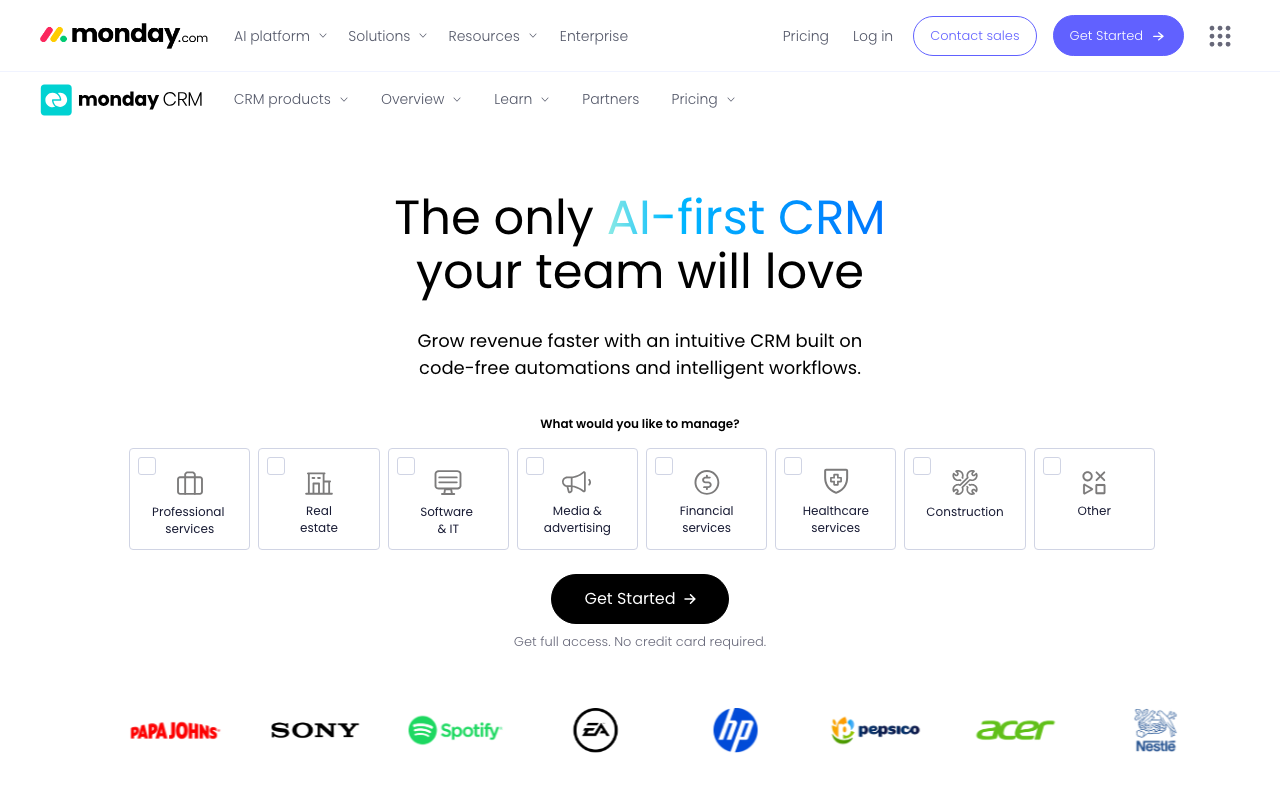
Who monday CRM is for
monday CRM is for teams that already run their work on monday.com and want their pipeline to live in the same place as their projects, ops, and dashboards. If your week is spent inside monday boards and you would rather not bolt on a separate sales tool, monday CRM gives you contacts, deals, and forecasting in the workspace you already know. RevOps-minded founders and small commercial teams that value customization over sales-specific defaults get the most out of it.
It is a weaker fit if you want a CRM that ships ready for selling on day one. monday CRM is a configurable platform first and a sales tool second, so you spend time shaping boards into something a rep can work fast. If you want opinionated sales workflows out of the box, Pipedrive is built around the pipeline from the start and gets a rep productive sooner. monday rewards the team willing to build.
A work-OS that you shape into a CRM
The core of monday CRM is the board. Each row is a contact or a deal, each column is a field or an automation trigger, and each view (Kanban, table, timeline, dashboard) is a different lens on the same data. That structure is what makes monday so flexible: you can model a sales process, a customer onboarding flow, and a renewals tracker in one workspace, and let updates flow between them. A contact change can fire an automation, push to a deal board, and surface in a report without any glue code.
The visual layer is where monday earns its reputation. Color-coded pipelines, drag-and-drop deal stages, and custom dashboards make pipeline health easy to read at a glance, which is part of why non-technical teams adopt it quickly. Built-in email sync, activity tracking, quotes and invoices, and over 200 prebuilt integrations cover most day-to-day CRM jobs.
The AI layer has expanded fast through 2026. monday now ships AI blocks for email drafting, column autofill, sentiment analysis, and meeting summarization, plus newer AI Sales and Lead agents that can triage and act on records. These work well as in-product helpers. The honest caveat is that monday CRM is not sales-specific by default, so capabilities like detailed forecasting and call logging feel lighter than what a dedicated sales CRM gives you.
Where monday CRM lands on AI-stack fit
monday CRM earns an 85 AI-stack-fit score, strong for the CRM category. The backbone is its GraphQL API, which is genuinely capable: it exposes nearly the full platform surface through a single endpoint, so an external agent or your own code can read and write boards, items, columns, and automations with real precision. GraphQL also pairs naturally with agent tooling, because an assistant can ask for exactly the fields it needs in one query. Note that the platform API is GraphQL-only; there is no REST option.
On MCP, monday is now a first-party story. monday.com ships an official MCP server (the mondaycom/mcp repo maintained by its AI team) that comes preinstalled on every account at no extra cost and supports CRM actions like creating leads and deals. That means an assistant such as Claude or Claude Code can drive monday CRM through a supported, turnkey path rather than a community wrapper. Combined with the native AI blocks that handle drafting and summarizing inside the product, that adds up to a CRM an agent can meaningfully operate.
Pricing notes
monday CRM bills per seat with four tiers: Basic, Standard, Pro, and a custom Ultimate plan. Pricing starts low on Basic and climbs through Standard (the volume sweet spot for most teams) and Pro (which adds the higher automation and forecasting ceilings). Two structural details matter. First, there is a three-seat minimum, so the headline per-seat rate is not the real entry price for a solo operator. Second, annual billing carries a meaningful discount over month to month, so the monthly option costs noticeably more.
Watch the limits, not just the per-seat number. Lower tiers cap active contacts, dashboards, columns per board, and monthly automation runs, and those ceilings are what push growing teams up a plan more than seat count alone. AI credits and the lighter AI helpers are included across plans, with the richest AI capabilities reserved for Ultimate. monday changes plan limits and AI packaging often, so confirm the current numbers, automation caps, and billing period on monday's pricing page before you commit.
The verdict
monday CRM is a solid choice if you want one flexible platform across sales and operations, especially if your team already lives on monday.com. The GraphQL API and growing AI blocks make it more agent-friendly than most CRMs in its price range, and the visual boards win over teams that found other CRMs rigid. Go in knowing the trade-off: you are buying a build-it-yourself work-OS, not a sales-native CRM, so budget setup time and watch how costs climb with seats, limits, and add-ons.
Weighing options? Pipedrive is the better pick if you want a pipeline-first CRM that works out of the box, and HubSpot Sales Hub makes sense if you want sales tied into a broader marketing and service suite. See the full best crm roundup for the head-to-head.