

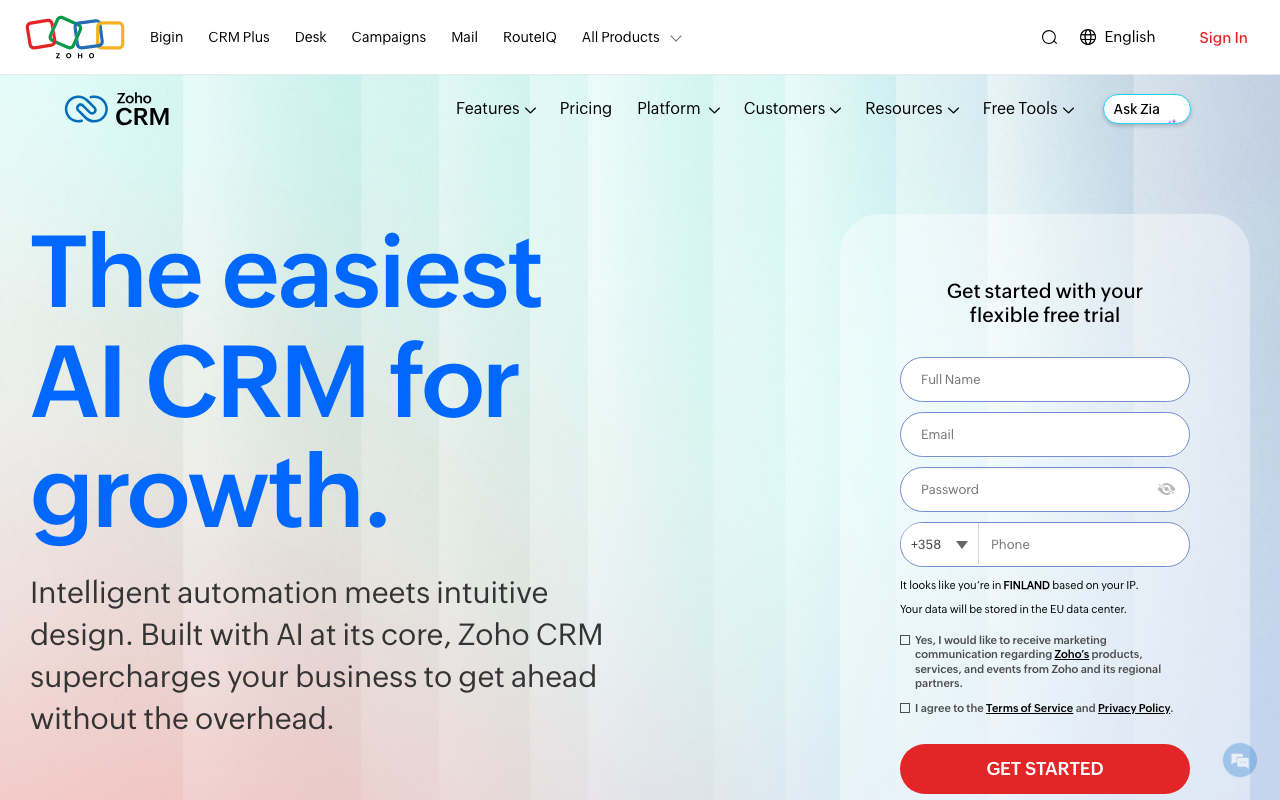
Who Zoho CRM is for
Zoho CRM is for the budget-conscious team that wants a lot of CRM for very little money. If you are a small or mid-size sales team that needs leads, deals, pipeline automation, forecasting, and a genuine AI assistant, and you would rather not pay HubSpot or Salesforce prices to get there, Zoho gives you more capability per dollar than almost anything else in the category. Founders running lean and ops people who already use other Zoho apps get the most out of it.
It is a weaker fit if a clean, modern interface matters to you. Zoho CRM is dense, and the UI can feel dated next to newer tools. A small team that values speed and polish over feature breadth will be happier with Pipedrive, which does less but does it in a calmer, more obvious way. Zoho rewards teams that will actually use the depth, not ones that want the fewest possible clicks.
A full sales platform at a small-tool price
The core of Zoho CRM is conventional and complete: leads, contacts, accounts, deals, and pipelines, with workflow rules, assignment rules, and approval processes layered on top. Where it earns its reputation is the sheer amount that comes bundled. You get sales forecasting, multichannel follow-up cadences, custom reports and dashboards, and on higher tiers things most CRMs sell separately, like CPQ, inventory management, territory management, journey orchestration, and customer portals.
Blueprint is the feature longtime users point to first. It lets you encode your actual sales process as a state machine, so reps can only move a deal forward by completing the required step, with the right fields and approvals enforced at each stage. For a team trying to make a messy process repeatable, that is more structure than most mid-market CRMs offer out of the box.
Zia, the AI layer that is actually included
Zoho's AI assistant, Zia, is the other reason teams pick it. Zia handles lead and deal scoring on a 1 to 100 scale from your historical conversion patterns, predicts deal outcomes, flags anomalies in your numbers, runs sentiment analysis on email, and turns natural-language questions into charts through Ask Zia. Call summaries get auto-condensed into a paragraph plus action items.
The pricing logic behind Zia is the interesting part. Where Salesforce Einstein and HubSpot Breeze tend to sit behind separate add-on licences, Zia is bundled into the CRM licence on the plans that include it, with no extra AI seat to buy. For a team watching costs, getting native AI scoring and prediction without a per-seat surcharge is a real advantage, even if Zia's outputs are not always as sharp as the premium-priced competition.
Where Zoho CRM lands on AI-stack fit
Zoho CRM scores 86 on CR Buddy's AI-stack-fit scale, near the top of the category. It earns that on both fronts. Zoho's REST API (now on v8) is comprehensive and well documented, exposing records, search, bulk operations, and even a Zia Assistant endpoint you can query with your org context. If you want to pipe CRM data into your own code or an external model, the surface area is there, and Zoho Flow plus Zapier and Make cover the no-code automation paths.
The bigger reason for the high score is direct agent control. Zoho now ships official, pre-built MCP servers for Zoho CRM, split by job: data query and insights, record operations, module customization, and workflow automation. You install them into Claude Desktop, Cursor, or VS Code and an assistant can read and act on the CRM through a first-party MCP connection rather than only the REST API. Between official MCP servers and a deep REST API, Zoho is one of the more agent-ready CRMs going. As always, check Zoho's current developer docs for the exact setup and which server covers the actions you need.
Pricing notes
Zoho CRM starts free for up to 3 users, which is a genuinely usable tier for a tiny team that needs leads, deals, and basic workflows. Paid plans run from a low entry price, billed annually, up through Standard, Professional, Enterprise, and Ultimate, with each tier unlocking more depth: scoring and cadences lower down, CPQ and process automation in the middle, and the full Zia AI assistant, journey orchestration, and territory management on Enterprise and above.
Two honest caveats. First, annual billing carries the headline rates, and month-to-month costs more, so the cheap-CRM reputation assumes you commit for the year. Second, the best value shows up when you live inside the broader Zoho ecosystem or Zoho One bundle, where the CRM stops being a standalone purchase. Zoho also lists prices in different currencies by region, and tiers shift, so verify the current numbers and what each tier includes on Zoho's pricing page before you buy.
The verdict
Zoho CRM is the value pick in this category. You get a ton of capability, native AI that does not cost extra on the right plan, and a deep API, all for less than the better-known names charge. The trade is the interface, which is dense and dated, and the fact that the economics make most sense if you buy into more of Zoho's suite.
If polish and ease matter more than breadth, Pipedrive is the friendlier small-team CRM, and HubSpot Sales Hub is the move if you want a slicker platform and a deeper free tier to grow into. See the full best crm roundup for the head-to-head.