

Who People Data Labs is for
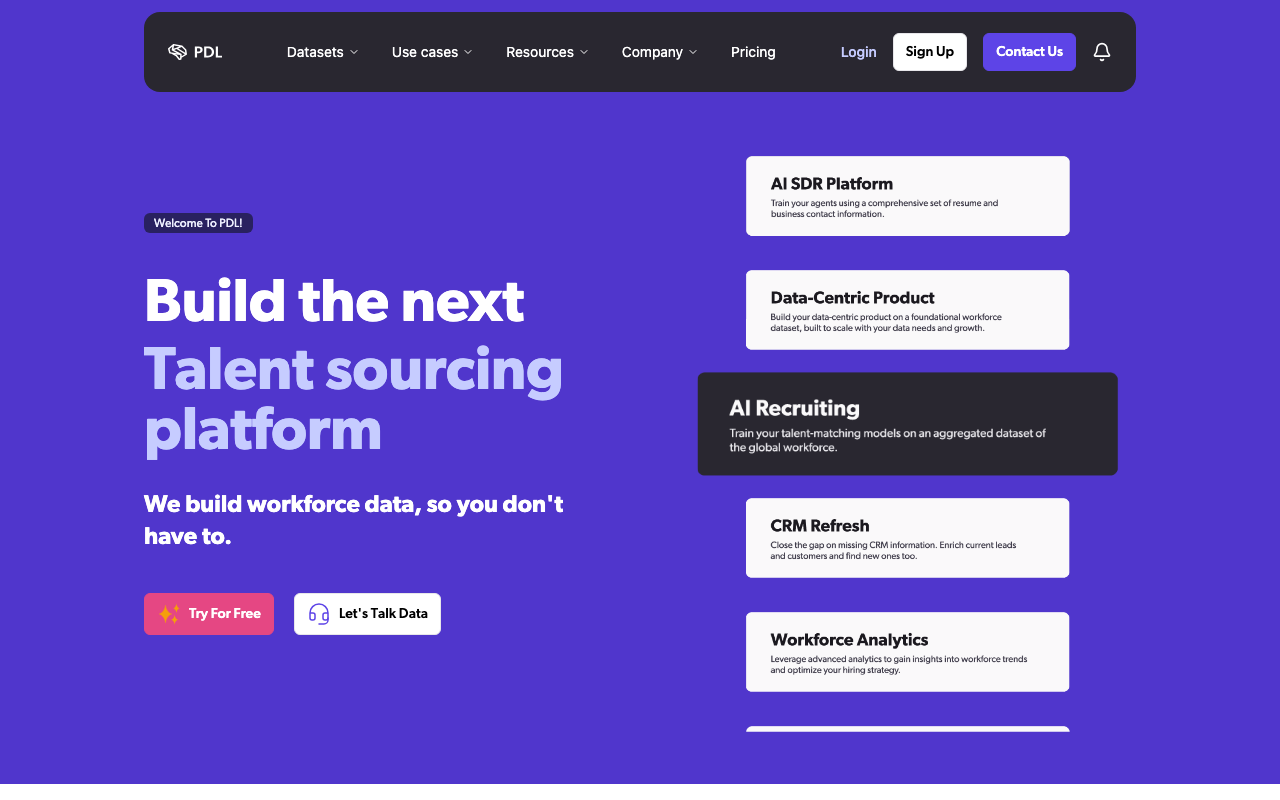
People Data Labs (PDL) is for the team that wants to build enrichment, not buy a finished prospecting app. If you have an engineer who can call an API, PDL hands you raw person and company records that you pipe into your own database, your CRM, a Clay table, or an agent workflow. GTM engineers, RevOps people building internal tooling, data teams, and product teams adding contact data to their own software get the most out of it.
It is the wrong tool if you want to log in, search a list, tick some boxes, and export verified emails. PDL has no contact-browsing dashboard, no CSV upload-and-enrich flow, and no sequencing. A solo AE or a small team that just wants leads and outreach in one place should look at an all-in-one like Apollo. PDL pays off when the data plumbing itself is the project.
What People Data Labs actually does
PDL is a data API. You send it an identifier, a name and company, an email, a LinkedIn URL, a domain, and it returns a structured record: job title, employment history, education, skills, location, company size, industry, and where available contact fields. The company claims roughly 3 billion person profiles and broad company coverage across 200-plus countries, though that figure includes historical and partial records, so real match quality depends on your query and your segment.
The product splits into a few APIs worth knowing. Person Enrichment does a one-to-one match against a profile. Person Search runs SQL-like or Elasticsearch-style queries to pull cohorts that fit a firmographic or demographic filter. Person Identify resolves a messy or partial input to a best match. The company side mirrors this with Company Enrichment and Company Search, and there is an IP Enrichment API for resolving visitor traffic to a company. Job posting data rounds it out for hiring-signal plays.
Coverage skews strongest where you would expect a data vendor born in San Francisco to be strong: North American tech workers, software engineers, product managers, and leaders at US companies with 50-plus employees. If your ICP sits well outside that, run a test batch before you commit budget. That is true of every data provider, and PDL is honest enough that you can measure it yourself with the free credits.
Standout strengths
The documentation and developer experience are the real draw. PDL ships working code samples in Python, Node.js, Ruby, Go, and cURL, maintained SDKs, and docs that read like they were written for engineers rather than for a buyer. Bulk enrichment endpoints let you enrich thousands of records in a run, which matters when you are backfilling a CRM or refreshing a warehouse.
The other strength is composability. Because PDL is a clean data layer and nothing more, it slots into whatever you already run. Teams use it as one provider inside a Clay waterfall, as a Snowflake or Databricks data share, or as the enrichment step behind a homegrown lead-scoring model. You are not buying a workflow, you are buying a building block, and that is the point.
Where People Data Labs lands on AI-stack fit
PDL earns an 80 on CR Buddy's AI-stack-fit score, and the reason is structural: a pure data API is exactly the kind of tool an agent can drive. There is no UI to click through, just typed inputs and JSON outputs, so an assistant like Claude can call enrichment or search as a tool and get clean, parseable data back. The generous free tier also means an agent can experiment without burning a budget on the first run.
The one asterisk is MCP. PDL does not ship a first-party MCP server, so the official integration path is the REST API and SDKs. What exists today are community MCP wrappers, including the open-source phxdev1 server and connectors on Composio and Pipedream, which expose person enrichment, search, company lookups, and autocomplete to any MCP client. Those work well and are why PDL scores high, but a community wrapper is not a vendor-maintained server, so treat it as a sensible bridge rather than a guarantee. For most agent builds, calling the REST API directly is the cleaner and more durable route.
Pricing notes
PDL runs a free plan, then a self-serve Pro plan, then custom enterprise pricing. The free plan gives 100 person and company lookups a month with no contact data, enough to test match rates on your actual ICP before paying. From there the published Pro plan is $98 a month billed monthly, or $940 a year, which works out to roughly 20 percent off for paying annually. Larger volumes move to custom enterprise pricing that user reports put well into four figures a month. Credits are consumed per successful match, so a search-heavy workflow and an enrichment-heavy one can cost very differently on the same plan.
Because the plans, credit allowances, and per-credit rates change, verify the current numbers on the vendor's pricing page rather than budgeting off any figure quoted here. The honest caveat: usage-based data pricing rewards teams that meter their calls and punishes sloppy pipelines that re-enrich the same records, so build in caching and dedupe from day one.
The verdict
People Data Labs is a foundational data API, and judged as that it is one of the better options for anyone constructing custom GTM tooling or agent-driven prospecting. The trade is plain: you get clean, well-documented data and total flexibility, and in return you supply the engineering. If you want a finished app, this is not it.
If list-building is the hard part of your motion and you would rather orchestrate providers than write code, Clay can use PDL as one source inside a waterfall. If you want enrichment and sequencing bundled in a turnkey platform, Apollo is the faster path. See the full best prospecting roundup for the head-to-head.