

Who Rox is for
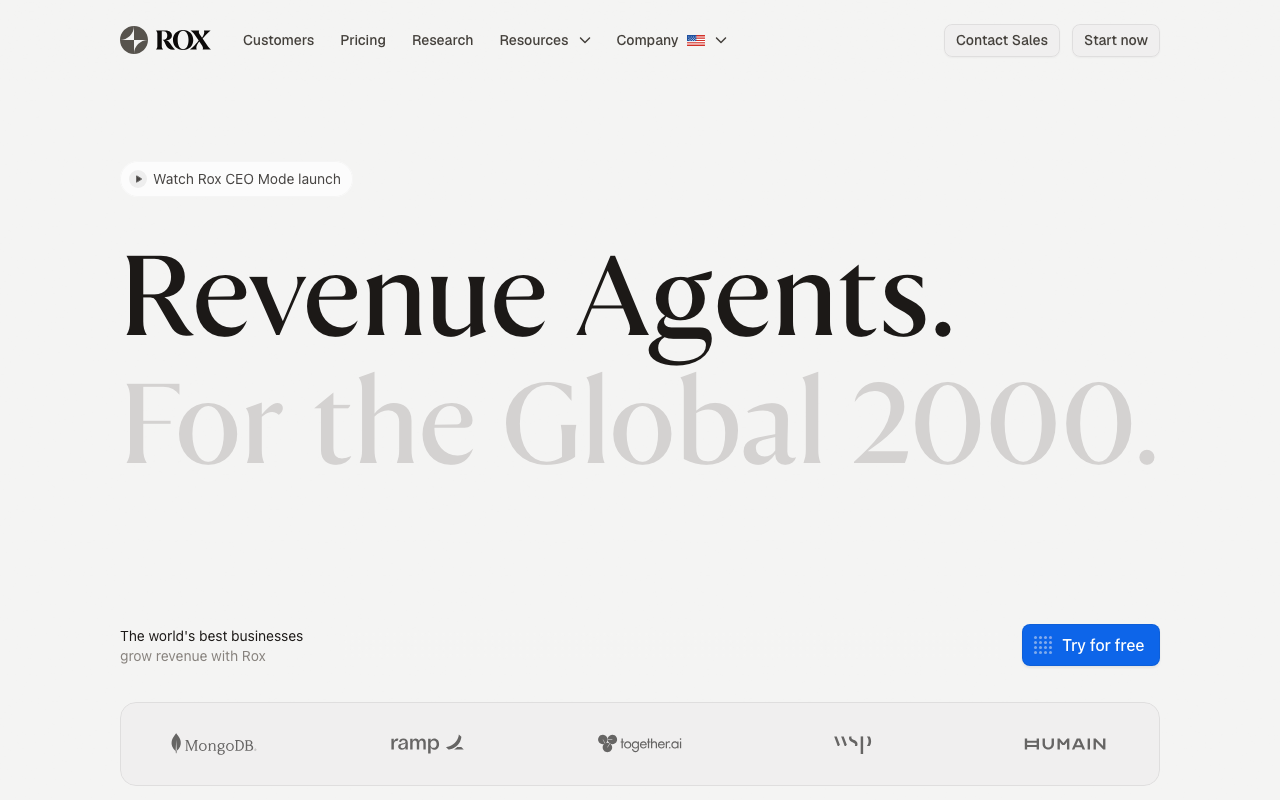
Rox is for enterprise revenue teams that want an AI agent layer sitting on top of their existing CRM, doing the account research, data enrichment, and record updates that reps either skip or do badly under quota pressure. Rather than a rep opening ten tabs to research an account before a call, the pitch is that an always-on agent has already done that work and written it back to the CRM before the rep needs it.
It's a strong theoretical fit for large, complex B2B sales orgs with the budget and CRM maturity (Salesforce, HubSpot) to give an AI agent meaningful write access to production data, and Rox's early customer list (Ramp, MongoDB, New Relic) signals it's being trusted at that level already. It's a weak fit for smaller teams or anyone wanting predictable, published pricing: Rox is unmistakably enterprise-first, both in who it sells to and in how opaque the pricing is.
What Rox actually does
Rox positions itself as an AI agent platform for revenue teams, with agents that research target accounts, enrich contact and company data, and read and write directly into the CRM without a human manually keying updates. The company describes surfaces across web, a native Mac app, and API access, which suggests the agents are meant to be embedded in how reps actually work day to day rather than living in a separate dashboard reps have to remember to check.
Native connectors into Salesforce, HubSpot, and Zendesk are the backbone: Rox reads existing account and case data, layers in research and enrichment, and writes updates back, aiming to keep CRM data current without relying on reps to do it manually, which is one of the most chronic failure points in enterprise revenue operations.
Where Rox lands on AI-stack fit
Rox scores 64 on the Chief Revenue Buddy AI-stack-fit scale. It has a real API and documented connectors for Salesforce, HubSpot, Zendesk, and Slack that support genuine read-write CRM automation, which is more than a lot of newer AI-SDR entrants ship at launch.
The score is capped by two things. First, there's no public MCP server, so despite being an "AI agent" product itself, Rox is not something Claude or another agent runtime can connect to and drive; the agent capability is closed inside Rox's own product rather than exposed for other assistants to orchestrate. Second, being founded in 2024, Rox is genuinely early: pricing, integration depth, and the durability of its enterprise contracts are all less proven than category incumbents. Score and category placement here should be read as "worth watching," not "settled."
Pricing notes
Rox does not publish pricing. What's known is that it's usage-based and quoted individually, split loosely into a Core tier (AI account agents, CRM enrichment, and research automation, sold by usage) and an Enterprise tier layering on custom integrations, advanced security, and dedicated support. There's no free trial or self-serve entry point, which fits the enterprise-only go-to-market but means you cannot test the product without a sales conversation.
Given the "usage-based" framing, the real question to ask in a sales cycle isn't the sticker price but what specifically is metered: seats, accounts touched, CRM actions taken, or something else. That number is what will determine whether Rox's actual monthly cost stays predictable at your team's scale.
The verdict
Rox is the buzziest of the newer AI revenue-agent platforms, with funding and marquee customers to back the pitch, but it's still early and closed off from the broader agent ecosystem: no MCP server, no published pricing, and a track record measured in months rather than years. If deep, automated CRM read-write is what you're after and you have enterprise budget, it's worth evaluating directly against Nooks for the calling-heavy alternative or against a CRM with agent access baked in, like Attio. See the full best AI SDR and agent tools roundup and the AI-stack-fit leaderboard for how it stacks up.