

Who Nooks is for
Nooks is for SDR and BDR teams whose day is still built around the phone, and who want to multiply the number of live conversations a rep can have without hiring more reps. The core idea is a parallel dialer: instead of one call at a time, Nooks dials several numbers simultaneously and only connects a rep once a human picks up, filtering out voicemails, gatekeepers, and dead lines automatically. For a 20-seat outbound team doing high-volume cold calling, that alone can double or triple daily conversations.
It is a poor fit for teams that are not phone-first. If most of your pipeline comes from inbound, email, or LinkedIn, the parallel dialer sits mostly idle and you are paying for a capability you do not use. It is also not the right starting point for a small team just getting outbound off the ground; Nooks is built and priced for teams that already know calling works for them and want to scale it, not for teams still testing the channel. For that earlier stage, a lighter AI SDR tool like Artisan or Regie.ai is a cheaper way to find out what's working before committing to dialer infrastructure.
What Nooks actually does
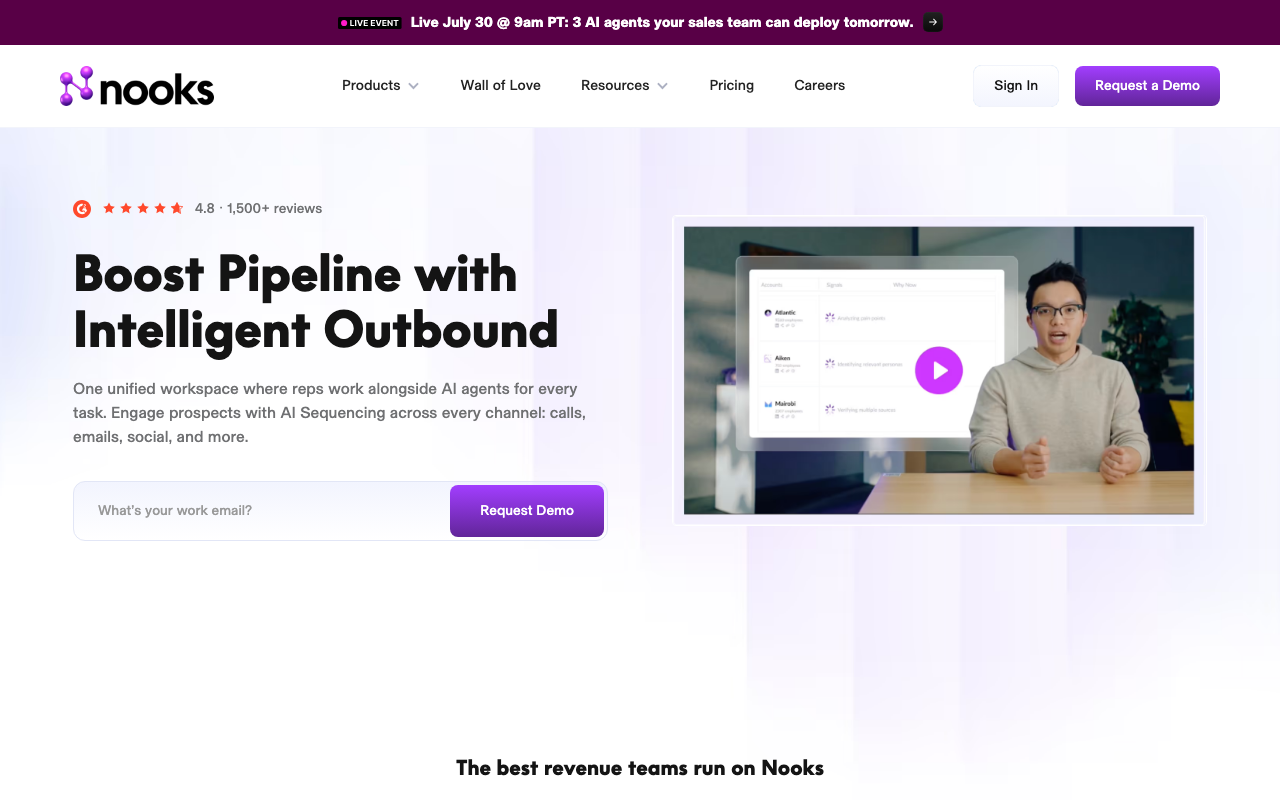
The parallel dialer is the anchor product: reps get connected to live humans back-to-back, with dead air and voicemail detection handled automatically so a rep's day is calls, not waiting. Layered on top is an AI-powered virtual salesfloor, meant to recreate the energy and coaching of an in-office bullpen for remote teams, including live call listening and peer leaderboards.
Nooks also ships conversation intelligence: calls are recorded, transcribed, and scored, with AI flagging talk-time ratios, objection handling, and moments a manager should coach on. A built-in prospecting and sequencing layer means reps can build lists and queue call blocks without leaving the workspace, so the tool spans from "who do I call" through "how did that call go" in one place. That breadth is Nooks' pitch: rather than stitching a dialer, a conversation-intelligence tool, and a sequencer together, one AI-native workspace covers the whole outbound loop.
Where Nooks lands on AI-stack fit
Nooks scores 64 on the Chief Revenue Buddy AI-stack-fit scale. It ships an official External API (documented at developer.nooks.in) plus native two-way syncs with CRMs like Salesforce and HubSpot and sequencers like Outreach, so call activity, dispositions, and analytics flow into the rest of your stack without manual exports. That is a real, working integration layer, not an afterthought.
What keeps the score in the mid-range rather than higher is the absence of an MCP server. There is no documented way today to point Claude or another agent runtime directly at Nooks and have it drive dialing sessions, pull call analytics, or manage queues conversationally. Everything routes through the REST API, which means integration work sits with your engineering team rather than being something an assistant can do out of the box. If Nooks ships an MCP server the way category leaders like Attio and Hunter.io have, this score has real room to climb.
Pricing notes
Nooks does not publish self-serve pricing; every plan is quote-based and sold annually with seat minimums, which is standard for dialer and conversation-intelligence infrastructure but makes it hard to comparison-shop without talking to sales. Third-party reporting and buyer forums put real-world costs in the range of $4,000 to $5,000 per user per year, which lines up with a Starter tier scoped for 5-15 seats, a Professional tier for mid-market teams, and an Enterprise tier at 50+ seats with API access and dedicated support layered on top.
Because none of this is published, budget a real sales cycle to get an accurate number for your team size, and push specifically on what counts toward "AI coaching" and "conversation intelligence" at each tier, since those are the features that most often get gated behind the higher plans.
The verdict
Nooks is the category-defining pick if outbound calling is genuinely your bottleneck and you have the budget to clear its price. The parallel dialer works as advertised, and bundling coaching and analytics into the same workspace beats stitching three separate tools together. But it is not a general AI-SDR platform, and the lack of an MCP server means it plugs into your stack over a standard API rather than something an assistant can drive natively today. If your team is not yet at the scale where a dedicated dialer pays for itself, weigh it against a lighter AI SDR tool like Qualified first. See the full best AI SDR and agent tools roundup and the AI-stack-fit leaderboard for how Nooks compares across the category.