

Who Relevance AI is for
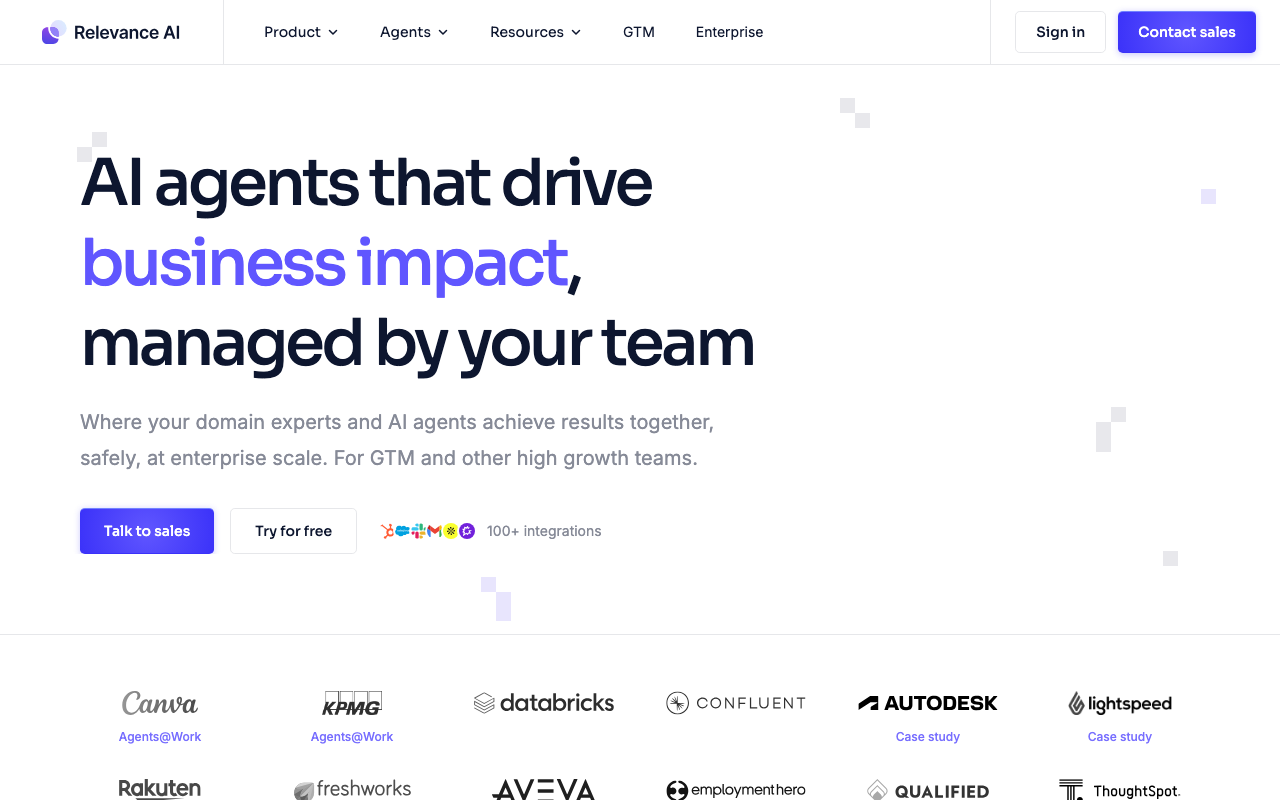
Relevance AI is for the person who wants to build their own sales agents, not rent a fixed one. If you think in terms of "have one agent research the account, a second qualify the lead, and a third write and send the email," Relevance AI gives you the building blocks to assemble that team yourself. GTM engineers, RevOps people, and ops-minded founders who like owning their automation get the most out of it.
It is a worse fit if you want a turnkey AI SDR that works on day one. Relevance AI is a platform, not a finished product, and the agents you build are only as good as the prompts, tools, and evals you give them. A founder who just wants an autonomous rep booking meetings without building anything will get there faster with a packaged AI SDR like Artisan. Relevance AI pays off when the workflow itself is the thing you want to control.
A platform for building a custom AI workforce
The core idea is an "AI workforce." Instead of one chatbot, you build specialized agents that each own a job, then have them coordinate. Relevance AI ships native orchestration for this, with parallel streams, nested sub-agents, and production monitoring, so a Lead Researcher can hand off to an Email Copywriter who hands off to an Outbound Sender. The platform leans hard into letting non-engineers own agent quality, not just the people who can write code.
There are three ways to build. The Invent flow lets you describe what you want in plain language and have the platform draft the agents, tools, and evaluations for you. A drag-and-drop builder lets domain experts refine those agents without code. And a programmatic path lets engineers build through the API and MCP. You can mix all three on the same project, which is rare in this category.
The standout for sales teams is the prebuilt agent library. There are 400-plus templates covering BDR outreach, prospect research, content generation, and data analysis, including a well-known outbound SDR agent. Pair that with 1,000-plus integrations to tools like HubSpot, Salesforce, LinkedIn, Apollo, and Gong, and agents can actually read and write across your stack rather than living in a sandbox. The Evals feature is the part that separates serious users from tinkerers: you define success criteria like email quality or qualification accuracy, and the platform measures every production run against them. That feedback loop is how you stop an agent from quietly degrading.
Where Relevance AI lands on AI-stack fit
Relevance AI earns its 84 AI-stack-fit score because it is an agent platform by design, not a SaaS app with an AI feature bolted on. It is LLM agnostic, so you can run agents on OpenAI, Anthropic, Google, or Meta models, and on paid plans you can bring your own API keys.
On the control side it covers the bases that matter. There is a full REST API for building and running agents programmatically, so your own code can trigger and read from agents directly. Relevance AI also ships an official Model Context Protocol server, documented in its integrations docs, so an assistant like Claude Code, Cursor, or Codex can plug into Relevance AI and build or drive agent workflows from your IDE. Relevance AI calls this "Programmatic GTM." That combination of a real REST API plus a first-party MCP server is why it scores near the top of the AI SDR category.
Pricing notes
Relevance AI restructured its pricing in September 2025 and now splits cost into two meters: Actions, which is what your agent does, and Vendor Credits, which covers the underlying model calls. Vendor Credits carry no markup, and on paid plans you can bring your own API keys to skip them entirely. That is a fairer model than a single opaque credit, but it does mean your bill has two moving parts to watch.
The free plan is genuinely useful for learning, with a few hundred Actions a month, a small vendor-credit allowance, and unlimited agents and tools, though it caps you at one user and one project. Paid plans bill monthly and step up Actions, add more users and shared projects, and unlock scheduled runs and support. The entry paid tier sits in the roughly $19 a month range, with team and enterprise tiers above it adding unlimited agents, calling and meeting agents, SSO, and RBAC. Enterprise pricing is quote-based. Because the meters and tier limits change, verify the current Action allowances and prices on the vendor's pricing page before you commit.
The verdict
If you want to build a custom AI sales workforce and you are comfortable tracking usage, Relevance AI is one of the most flexible platforms available. The orchestration, the eval loop, and the API-plus-MCP story make it a strong base for agentic GTM. Go in knowing it is a build-it-yourself tool: budget time to design agents, write evals, and tune prompts before it earns its keep.
Comparing options? Lindy is the better pick if you want a friendlier no-code agent builder, and Artisan suits you if you would rather buy a packaged AI SDR than assemble one. See the full best ai-sdr roundup for the head-to-head.