

Who Lindy is for
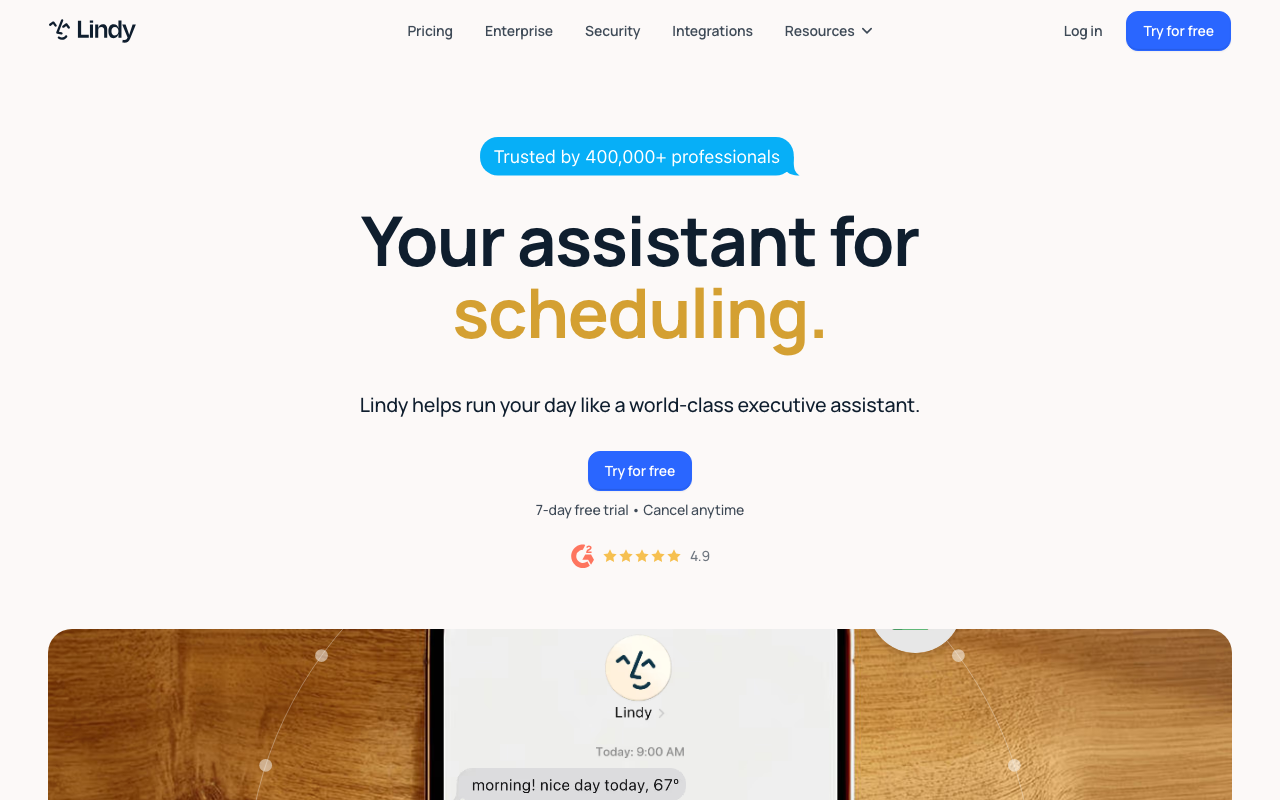
Lindy is for the operator who wants to build their own sales agents instead of buying a single-purpose AI SDR. If you can describe a workflow in plain language ("when a lead replies, draft a follow-up, log it in HubSpot, and book the meeting"), Lindy lets you turn that into a running agent without code. RevOps people, founders, and ops-minded AEs who keep finding repetitive glue work between their tools get the most out of it.
It is a worse fit if you want a turnkey outbound machine that researches accounts and sends sequences out of the box. Lindy hands you the building blocks, not a finished motion, so a rep who just wants pipeline tomorrow will move faster with a dedicated AI SDR like Artisan or a research-first agent like Aomni. Lindy pays off when the automation itself is the thing you are missing.
A no-code builder for sales agents
The core unit in Lindy is an agent (the product calls them "Lindys"). Each one has a trigger, a set of steps, and access to your connected tools. A trigger might be a new email, a calendar event, a webhook, or a schedule. The steps can call an AI model, read or write a record in your CRM, send a message, branch on a condition, or hand off to another agent. You assemble this in a visual builder and describe what you want in natural language, and Lindy figures out the tool calls.
What makes it useful for sales specifically is the integration surface and the trigger library. Lindy connects to Gmail, Slack, HubSpot, Salesforce, calendars, and a long list of other apps, so an agent can watch an inbox, qualify an inbound lead, enrich it, draft a reply, and update the pipeline in one pass. Meeting workflows are a common starting point: Lindy can take notes, summarize the call, and push action items and next steps into the CRM without a rep touching anything.
The product also lets you pick the underlying model per agent, including recent Claude and GPT options, so you can route heavier reasoning to a stronger model and keep cheap, high-volume steps on a faster one. That flexibility is rare in this category and is part of why Lindy reads as an agent platform rather than a chatbot with a few automations bolted on.
Where Lindy lands on AI-stack fit
Lindy scores 50 on Chief Revenue Buddy's AI-stack-fit scale, which puts it in the middle of the AI SDR group. Lindy is built to act across your tools, but the ways an outside agent can drive Lindy itself are limited. The main inbound hook is a webhook trigger: another service or agent can POST to a Lindy with a bearer key to kick off a workflow. For outbound work, Lindy includes an HTTP Request action that lets one of its agents call another product's API. What Lindy does not publish is a documented public REST or GraphQL API to manage or invoke the platform programmatically, so it sits below tools that expose a full developer API.
On the Model Context Protocol, there is no verified Lindy MCP server. Some third-party write-ups claim Lindy ships an MCP server you can call from Claude or ChatGPT, but Lindy's own documentation does not confirm any MCP integration, and there is no Lindy MCP repository or registry entry to point to. Treat MCP support as absent until Lindy documents it. If you live in Claude Code or Codex and want first-class agent control, the practical path today is triggering a Lindy over its webhook, not piloting it turn by turn through MCP.
Pricing notes
Lindy is a paid product with no free plan. Every plan comes with a 7-day free trial, and paid pricing starts at $49.99 per month for Plus, billed month-to-month. Pro is $99.99 per month and Max is $199.99 per month, each stepping up usage and inbox counts. Enterprise pricing is custom and adds SSO, SCIM, audit logs, and compliance options.
The thing to watch is the credit model. Usage is metered, and AI-heavy steps like web research or email parsing burn more credits than a simple trigger, so two teams on the same plan can see very different bills depending on how busy their agents are. Voice calls and phone numbers are billed separately on top of credits. Plan tiers are described mostly as multiples of usage rather than fixed task counts, which makes it hard to predict cost until you have run real workflows. Treat the early weeks as a calibration period, and verify current prices, credit allowances, and any add-on rates on Lindy's pricing page before you commit, since the structure changes.
The verdict
Lindy is one of the stronger no-code agent builders for sales automation, and the 7.9 score reflects that. If your bottleneck is the repetitive work between your CRM, inbox, and calendar, Lindy can absorb a real chunk of it, and the per-agent model choice plus deep integration list give you room to grow. Go in expecting to invest time in prompting and to keep an eye on credit consumption, because powerful agents are also the expensive ones.
If you want more developer-grade control over agents, Relevance AI is worth a look, and Bardeen is the lighter pick for browser and CRM busywork. Compare the field in the best ai-sdr roundup.