

Who Breakcold is for
Breakcold is an AI-native CRM for people who sell through conversations rather than through forms. If your pipeline moves in LinkedIn DMs, email threads, and the occasional WhatsApp message, and your current CRM only knows about the email half, Breakcold is built for exactly that gap. The vendor aims it at solopreneurs, consultants, agencies, recruiters, and sales teams in the 5 to 30 seat range, and the product shape matches: fast to set up, light on admin, no implementation partner required.
It is the wrong tool if you need enterprise governance. Territory management, deep approval chains, multi-product quoting, and a large certified-partner ecosystem are not what a small Paris team is building. Teams that need that should look at Salesforce Sales Cloud or HubSpot Sales Hub and accept the setup cost that comes with them. If you want a low-admin CRM that auto-logs email and calls but do not care about LinkedIn, Salesflare covers the same ground with a longer track record.
The unified multichannel inbox
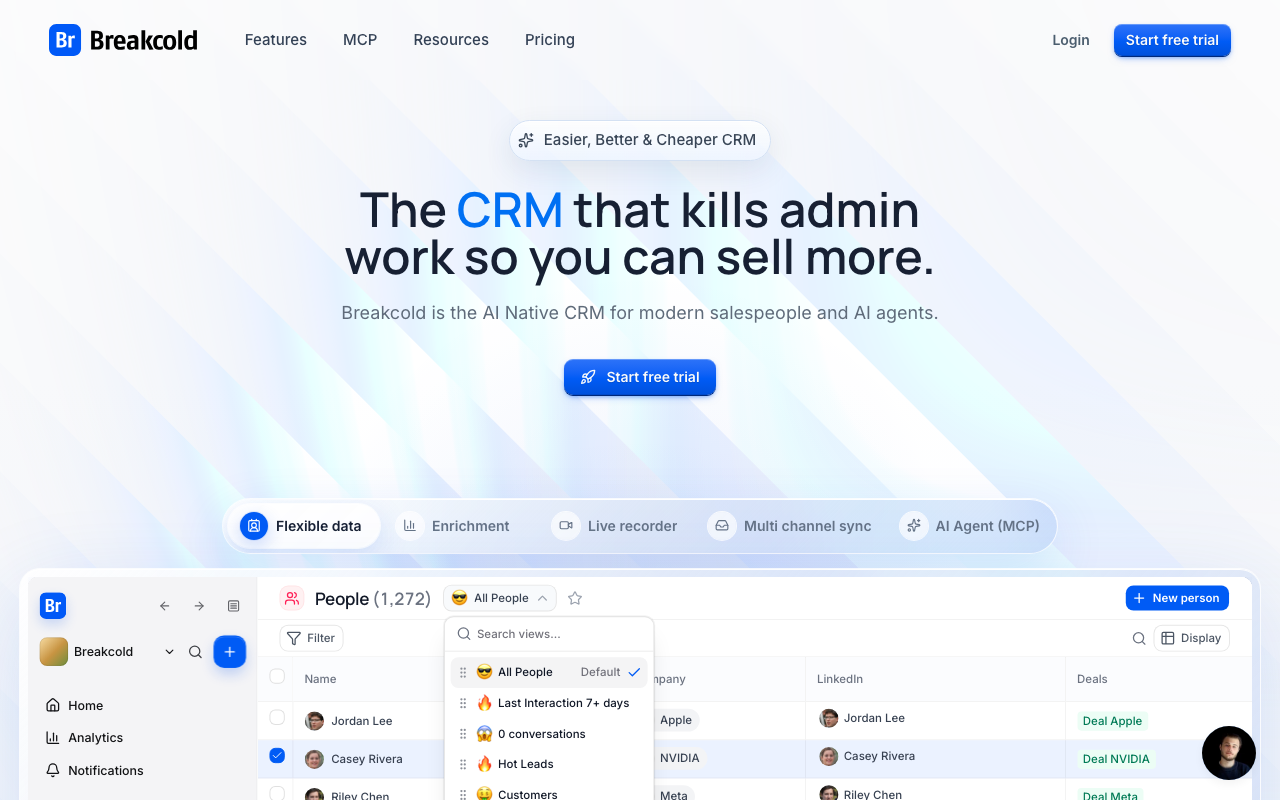
The core feature is the inbox. Breakcold connects Gmail or Outlook plus LinkedIn, WhatsApp, Telegram, and Instagram, then syncs those conversations onto the contact record automatically. One person, one timeline, regardless of which channel the last message arrived on. For social sellers this is the difference between a CRM that reflects reality and one that shows a contact as cold because the last three exchanges happened on LinkedIn.
Around the inbox sits a standard but competent CRM: visual Kanban pipelines, custom objects and fields, tasks, notes, companies, and roles and permissions for teams. Contacts are unlimited on every account, which matters more than it sounds when the alternative is a per-contact tier ladder. Enrichment is built in rather than bolted on: paste a LinkedIn URL and Breakcold fills out up to roughly 50 data points, with email and phone waterfall enrichment for the fields that need multiple providers. A meeting recorder captures transcripts, notes, and action items on calls, so the timeline picks up voice conversations too.
The AI layer handles the admin. Breakcold's CRM agents tag leads, create follow-up tasks, move deals between stages, and draft replies in your voice. That work runs on a token allowance rather than being unmetered, which is the main thing to model before you commit.
Where Breakcold lands on AI-stack fit
Breakcold scores 87 on the Chief Revenue Buddy AI-stack-fit scale, which puts it in the top tier of CRMs, just behind Attio and Close at 88. The reason it scores this well is not marketing language about being AI-native, it is the shape of the integration surface.
Breakcold runs its own hosted MCP server with separate US and EU endpoints (http.us.breakcold.com/mcp/v1 and http.eu.breakcold.com/mcp/v1). Authentication supports OAuth 2.0 for clients where a human signs in, and bearer tokens for service-style agents, with an X-Breakcold-Organization-Id header for multi-org setups. The 62 exposed tools are generated from the same public OpenAPI contract that backs the REST API, so agents get parity with the product rather than the read-only slice most vendors ship first.
That parity is what separates it from the pack. An agent connected to Breakcold can read and write people, companies, deals, tasks, notes, custom fields, and pipeline views, and it can reach the multichannel inbox to send and reply, not just read. Most CRM MCP servers stop at CRM objects and email activity. Breakcold puts LinkedIn, WhatsApp, Telegram, and meeting data behind the same interface.
Setup guides live in the public github.com/breakcold/mcp repository and cover Claude and Claude Code, ChatGPT, Codex, Microsoft 365 Copilot, LM Studio, LibreChat, and TypingMind, alongside IDE agents like Cursor and framework integrations for LangChain and LlamaIndex.
Two caveats hold it below Attio and Close. First, that repo is documentation and generated metadata, not a self-hostable server: the runtime is Breakcold's hosted service, so your agent access depends on their uptime, and there is no self-host path if you need the data to stay on your own infrastructure. Second, the tool count and the coverage claims are the vendor's own documentation. Breakcold does not yet carry a listing in Claude's Connectors directory or ChatGPT's, which is the independent confirmation Chief Revenue Buddy weights when a vendor describes its own agent surface. The documentation is specific and checkable enough to take seriously, and the score reflects that, but it is one notch below tools whose access has been confirmed from outside.
For the rest of the stack, Breakcold ships 20+ native integrations including Lemlist, Slack, Zapier, and Make, which covers the no-code paths that do not warrant a custom build. If you want to compare the agent story against other modern CRMs, the AI-stack-fit leaderboard ranks the whole field, and Attio is the closest comparison on API depth.
Pricing notes
Breakcold sells one plan at $59/mo, billed monthly, with no annual option advertised. That covers 1 seat and 2 connected accounts, with additional seats and additional connected accounts each at $10/mo. Included in the base price: unlimited contacts, unlimited person and company enrichment, the multichannel inbox, the meeting recorder, email and phone waterfall enrichment, Claude, ChatGPT, and MCP access, and roles and permissions. A 14-day free trial is available at signup.
The variable to watch is the token allowance. The plan includes 3,000 AI CRM action tokens per month, and per Breakcold's documentation each AI CRM action consumes roughly 0.5 tokens, with metadata enrichment free and unlimited. For a solo operator that ceiling is generous. For a five-person team running agents against the CRM all day, model the burn before you assume the flat price is the whole bill.
Run the math per seat and it lands well: a three-person team with three inboxes is roughly $59 plus $20 for seats plus $10 for the extra inbox, which is cheaper than three seats of most mid-market CRMs and includes enrichment those tools charge separately for. Prices were verified on the vendor pricing page on 4 August 2026. Small vendors adjust pricing more often than incumbents, so check the current numbers before you commit.
The verdict
Breakcold is worth a serious look if your sales motion is multichannel and your working environment is an AI assistant. The unified inbox solves a real problem that email-only CRMs quietly ignore, the flat $59/mo pricing with unlimited contacts and enrichment is honest, and the MCP server gives agents write access to conversations rather than a read-only object dump, which most CRM MCP servers still do not.
The trade-offs are the ones you would expect from a lean, bootstrapped vendor: less enterprise depth, a smaller integration catalogue than the incumbents, a metered AI allowance you should size before you buy, and an agent surface that is documented rather than independently verified. None of that is disqualifying for the teams it targets. If you want the safest pick in the category, Attio has the longer track record and the same top-tier agent access. If you sell across LinkedIn and WhatsApp as much as email and want that history reachable from Claude or ChatGPT, Breakcold does something the rest of the best CRM list does not.