

Who Swan is for
Swan is for teams that keep having good GTM ideas and no one to build them. The pitch is literal: you describe a workflow in plain English, and Swan turns it into an agent that runs on a trigger and keeps running. Watch a target account's LinkedIn for engagement and open a conversation. Pull the closed-lost list every Monday and check whether the competitor that beat you just had a bad quarter. Brief the rep before every call. In a normal stack each of those is a RevOps ticket, a Clay table, and three Zapier steps. Here it's a paragraph of instruction.
That makes it a fit for RevOps teams who are the bottleneck for everyone else, founder-led sales teams with no RevOps at all, and marketers who want to test a campaign without filing a request. It's a poor fit if you need the underlying data in your own systems, for reasons covered below, or if you're buying a predictable per-seat tool: this is metered software and your bill moves with how much work you ask for.
The company is worth knowing about before you commit. Swan was founded in 2024 in Tel Aviv by three people, raised $6M, and reached 200+ customers in 2025 while staying a three-person team, on purpose. That is the product thesis made flesh, and it cuts both ways: impressive proof that the agents work, and a real question about support depth and continuity if you make Swan load-bearing.
Prompt to pipeline, and what actually runs it
The interesting part of Swan isn't the chat box, it's the triggers. An agent is only useful if something fires it, and Swan ships a genuinely broad set: LinkedIn posts, comments, and reactions on tracked profiles; Bombora intent topics; business events like funding, hiring, and leadership changes; website visitors resolved to a person or company through its own tracking script; HubSpot workflows; inbound webhooks from anything that can POST; and plain schedules for digests.
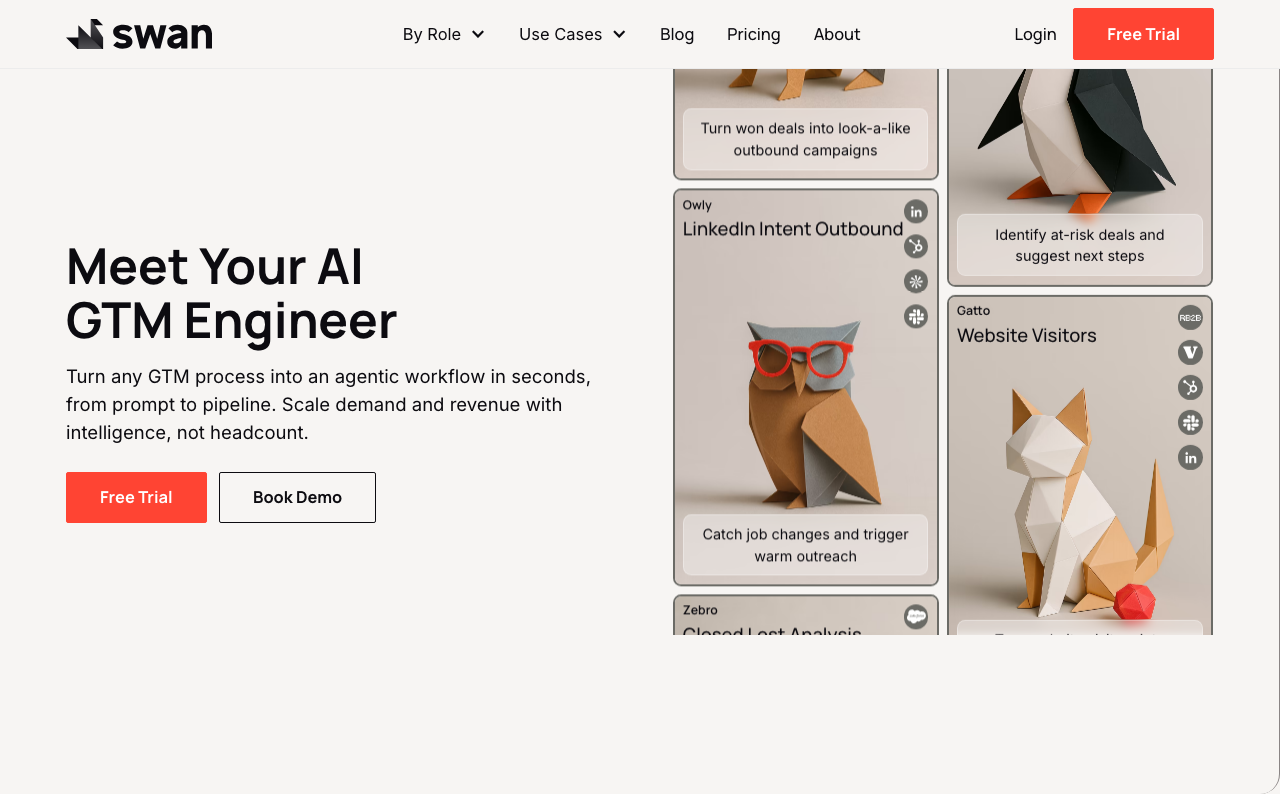
Six prebuilt agents ship as starting points, each with a name and a job: LinkedIn intent outbound, lookalike campaigns from closed-won, closed-lost competitor analysis, visitor identification, meeting prep, and at-risk pipeline monitoring. They're templates rather than a ceiling, and the more useful framing is that they show you the shape of a good Swan agent before you write your own.
Approvals are the part most agent tools get wrong and Swan gets right. Work that sends or writes pauses for human sign-off, and that gate holds no matter how the work was started, including from an external agent. You can dial it down, but the default is that Swan drafts and you approve.
Where Swan lands on AI-stack fit
Swan scores 80 for AI-stack fit, which is good but sits below the CRM leaders, and the reason is worth understanding because it's unusual.
The MCP story is genuinely strong, and it runs both directions. Swan exposes a first-party hosted MCP server at mcp.getswan.com/mcp using OAuth rather than API keys, with org-scoped endpoints if you belong to more than one workspace. Four tools are exposed: send-message, get-conversation, list-conversations, and cancel-conversation. Point Claude or Claude Code at it and you can hand Swan a task from your own agent, then collect the result when it finishes. Long runs return a status and a short-lived polling URL rather than blocking, which is the correct design for work that takes minutes. In the other direction, Swan is an MCP client: connect your own MCP servers and the agent picks them up as tools. Very few GTM products do both.
What holds the score down is data portability. Swan has no public REST or GraphQL API, and it doesn't pretend otherwise. Its documentation states plainly that the MCP server is "not a REST data API" and points you to CRM sync or webhooks to move data. Chief Revenue Buddy verified the OpenAPI file published at docs.getswan.com/api-reference/openapi.json and found Mintlify's unedited "Plant Store" sample: two endpoints about plants, pointing at a Mintlify sandbox domain. That's a docs oversight rather than a lie, since nothing on the site claims a data API exists, but it means there is no programmatic read surface at all today.
Two smaller frictions: the MCP server is off by default until an admin enables it in settings, and a connection is capped at five concurrent conversations. Neither is a blocker, both are worth knowing before you plan an integration. If your priority is an agent-drivable system of record rather than an agent that does work for you, Attio and Breakcold are the better shape, and the AI-stack-fit leaderboard ranks the whole field.
Pricing notes
Swan is credit-priced: you pay for work performed, not for access. Four tiers, verified on the vendor pricing page and billing docs on 10 August 2026. Solo is $100/mo for 625 credits and 1 seat, with a maximum of 2. Starter is $200/mo for 1,250 credits, 1 seat, maximum 5. Growth is $419/mo for 2,000 credits, of which $99 is a platform fee, and includes 5 seats up to a maximum of 10. Scale is custom. Extra seats are $20/mo on every plan, and paying annually takes 20% off.
Two details decide whether this is expensive. First, top-up credits cost well above the in-plan rate: $0.37 per credit on Solo, $0.30 on Starter, $0.24 on Growth, against roughly $0.16 in-plan. Blowing through your allowance mid-month is the expensive way to use Swan, so size the plan generously rather than topping up habitually. Second, integrations are tier-gated in a way that will catch people out: HubSpot and Attio need Growth at $419/mo, and Salesforce and Gong are Scale-only. If you run Salesforce, the real entry price is a conversation with sales, not $100.
New orgs get a 14-day trial with 500 credits and no card required. If the trial lapses you land on a free plan that keeps your data readable but grants zero monthly credits and one seat, so treat it as read-only archive rather than a usable free tier.
The verdict
Swan is the most convincing version of prompt-to-pipeline that Chief Revenue Buddy has reviewed. The triggers are real, the approval model is honest, the documentation is unusually specific about limits and costs, and the two-way MCP support means it can both take work from your agents and use your tools to do it. For a small team without a GTM engineer, that combination does something no amount of Zapier will.
Go in clear-eyed on two things. Your data lives in Swan and leaves only through CRM sync or webhooks, which is a genuine constraint if you like owning your pipeline data. And the vendor is three people, which is the whole marketing story and also the main risk you're underwriting. If those sit fine with you, the trial costs nothing and 500 credits is enough to see whether the agents do what the demo says. Teams that want autonomous outbound with a longer track record should compare 11x and Artisan from the best AI SDR list first.